Thursday, July 4, 2019

River Cruising: Not Just for your parents anymore

Travel and Leisure

River cruising? I've heard of ocean cruising, but what is this? Well, I hadn't heard of it either, so I thought what better topic for the Travel and Leisure section? We're not experts on European travel, but after having sailed three times (now four) on river cruises, we are relative experts compared to others we know. That's why I thought I'd jot down some information here to help anyone out that may be considering a European river cruise. First in a series of four, this post will focus on the generic differences vs. other cruises or travel options, and we'll talk about the where to go, the best deals and what to expect in the next couple of posts. In the fourth post, I'll outline what a typical day is like while river cruising.

How did we find out about River Cruising?

Fairy tale castles of the Rhine Valley
Back in the early 2000s, she was a travel agent, and would occasionally get to go on FAM (FAMiliarization) trips or excursions. Usually, these would be company-paid, fully-escorted tours, accompanied by other travel industry professionals, and would be relatively high activity trips, visiting many hotels and properties along the way. Sometimes, it was simply a deeply discounted fare, with very little expected of her on the trip, except a brief tour or introduction by the operator, but would also allow for spouses to accompany them. So when she asked, "Do you want to go on a river cruise on the Rhine?", I quickly replied, "Hell yes!".
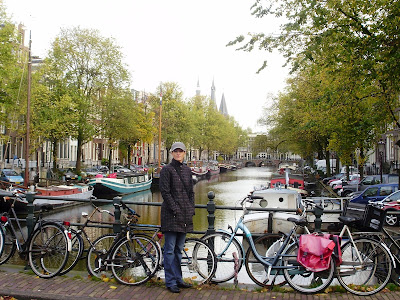
Typical canal scene in Amsterdam
In truth, she did not know much about river cruising either, and so this was a new experience for both of us. At that time (2009) we were already pretty adept at European vacations, and were used to planning our own agendas, booking accommodations and organizing the travel, but we were happy to try something that was all pre-planned for us. All we had to do, was get to Amsterdam, and arrange for return from Zurich. We gave ourselves two extra nights in A'dam, as we find that it helps get over the jet-lag if you don't try to rush right into something as soon as you arrive. After a day of wandering around the canal district and enjoying a nice meal in one of their Brown cafes, we headed to the dock to board our ship.
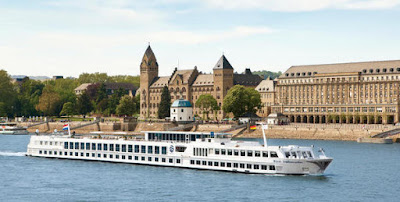
River cruise ship at sail
Image credit: cruisecritic.com
From the moment we stepped aboard Uniworld's River Ambassador, we knew we were in for something special. It wasn't the luxuriousness of the ship however; the River Ambassador was actually getting a bit long-in-the-tooth back then, and has actually been refurbished twice since, and has now been converted to join their U by Uniworld fleet. What we were taken aback by, is the exceptional level of service provided by all of the staff on board; with only ~120 guests per sailing, most crew members were addressing us by name within 24 hours! Each day, we woke up in a new city or town, were given a guided tour, and then had free time to explore on our own. The ship would be so close, we could walk back for lunch, or simply find a bite to eat locally. All meals were included once we had boarded, and we dined like royalty; full buffet breakfast with "American-style" options available, three-course lunches, and four or five-course dinners. Cruising occurred at night, and so we'd have to be on-board by 8 pm or so, when the ship would depart for the next destination. By the end of our trip, we were so sorry to see it come to an end that we vowed to do more river cruising in the future.
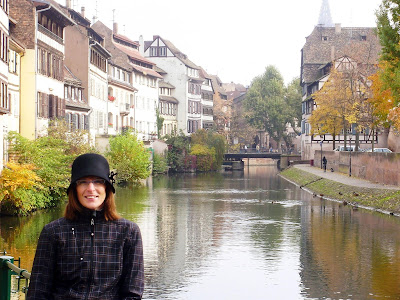
Strolling the canals of Strasbourg
Ok, so we did notice immediately, that we were the youngest couple on board, by at least a decade. Maybe even two. On one trip, we met a lovely couple from New York, and the husband commented, "you two must feel like kindergarteners with the rest of us around". But we didn't mind, and we have met many great people on our river cruise trips. It would only be an issue for those younger passengers when it comes to the "pace" of things. I'll leave it at that - we will all get old eventually, and hopefully others will be patient with us when we get old too. There are however, cruise operators that try to cater to a younger audience, such as the aforementioned U by Uniworld. However, in my opinion, river cruising has still not attracted the 30 to 40-something demographic due perhaps to the perceived notions of this style of travel, as well as the relatively high prices. But with respect to the latter, there are ways to cruise on a more moderate budget, but it requires flexibility and patience. More on that in another post.

What is River Cruising?

As you can imagine from the name, river cruising entails using a ship as your primary accommodations, dining and inter-city transfer vehicle on the various waterways that connect cities and towns throughout Europe. Some of these rivers are huge, and sometimes traversing particular regions is like being on a large lake, whereas others are narrow, and wind their way through picturesque, tree-lined river valleys. As such, the ships are limited in size by the locks and bridges throughout Europe - they are long and narrow, with a very shallow draft and flat-topped. Typically around 135m long, and only 12m wide, there is only room for a single hallway down the centre, with a small stateroom on each side.

Typical River Ship 3-deck Layout; credit: vantagetravel.com
These custom-built ships allow travellers to visit cities and towns that follow the path of the river; remember that back before modern transportation options, people congregated on the sides of rivers, as that was how you moved goods and people easily. As such, you will find that most ports have their city centres located literally steps away from where the river cruise ships dock. Some of the towns you will stop at end up being the highlight of the trip, when otherwise you would never have planned to go there on your own. While the rooms are quite small, even by European standards, there is plenty of space in the lounge or top deck to relax; you can get a drink from the bar and unwind after the day's exploring. With gourmet dining included on the ship, consider it as your own small, floating, European boutique hotel. And since there are so many small towns along the river, this style of travelling gives you an unique opportunity to see and visit places that you might not have visited on your own, self-guided travels.

What it Isn't

Ocean liner dwarfs river cruisers in Amsterdam harbour
The first response from travellers who have gone ocean cruising is, "Where are all the restaurants and entertainment options?". Expecting the facilities of a huge ocean vessel would be the first mistake that newbies make. Multiple restaurants and entertainment facilities are not what river cruising is about, nor would you want them. Leave the kids (if you still have them) at home; there isn't anything for children on board, or in Europe for the most part. There also aren't any lineups for restaurants, as there is a seat for everyone in the dining room. You won't find thousands of passengers on board either; with typical ship layouts having 70-90 staterooms, you will rarely have more than 120 passengers on river ship. And because the ship is small relative to an ocean liner, you won't be mooring in the main harbour or anchoring off-shore and having to tender back and forth to the ship. No, the crew can moor a river ship in 15-20 minutes, and then a gangplank is dropped to allow passengers to easily come and go as they please. For those that want a full-day onshore, you can easily accomplish that, as you typically don't need to wait for a tender or coach to take you into town; you can have an early bird, continental breakfast, and be off the ship exploring by 8 am. Similarly, since the ship usually doesn't leave until after dinner, you can stay in town and enjoy a drink at a local pub until close to 8:30 pm or so. With most services and tours included in the price of a river cruise, you won't be nickel-and-dimed to death either. Yes, there are optional tours that can be worthwhile, as well as additional alcoholic beverages that are not served in the dining room. But unless you go with a more budget-style river cruise operator (and they do exist), you don't have much more to pay once your board other than tips and incidentals.

River Cruise vs. Self-Drive vs. Rail vs. Bus Tours

ships raft together when port space is limited
The other way to see as much of Europe in such a short period of time, is either self-drive or bus tours. Self-drive is a great option if you prefer to have no fixed agenda, and are comfortable driving in new, foreign countries, sometimes with very small streets that do not have signage in English. Of course the onus is on you to find and book new accommodations along your route, as is the case with rail touring. Taking the train does take the stress out of inter-city travel, but it does require some comfort with public transport and transfers on each end; many of the sights and small towns accessible by the river network are also not necessarily on main rail routes. Of course there are tour operators that will offer similar itineraries to river cruising with their guided bus tours, but now you are really on fixed schedule. Not to mention that in order to see all the stops along the way that a river cruise would, you need to pack up and unpack each day in a new hotel. Often times, the bus tour requires that your bags be packed and put outside your room up to two hours before you are due to depart, which can be as early as 8 am!

get your shopping fix in Europe
Shop-till-you-drop in Europe
With a river cruise, if you have purchased air travel through the operator, a representative will meet you at the airport and your transfer to the dock is included. Once you embark upon your ship, you unpack only once. You need not worry about where to travel next, and virtually all transport takes place while you are sleeping, rather than waste valuable daytime hours on the road or taking the train. After a leisurely breakfast, you can choose to take the included walking tour of the town or attraction, then perhaps do some more exploring. Have a delicious lunch on board, or find some local cuisine in town. More touring or shopping perhaps? Then a cocktail back in the lounge where you can meet new friends and share highlights of your day. A gourmet dinner awaits in the dining room, and some local entertainment in the lounge after. Repeat for 7 days or more, and then disembark on your final day, where you are transferred to the airport for your flight home.

Next: Where to go, and with whom?

No fees or payment have been received from tour companies or river cruise operators.

Saturday, June 15, 2019

What luggage should I choose?

Travel and Leisure

I know, there's a million posts on the internet about what bag is best; wheeled vs. backpack, hard shell instead of soft-sided, etc. I'm offering my advice on specific styles, and what works best for me/us, but travel luggage and bags are ultimately going to be tailored by your specific needs. i.e. a week long beach vacation in Barbados isn't going to require the same things as a 2-month trek across Africa. For the most part, we're travelling from 14-21 days, and will be taking overseas flights, where the basic fare class includes one checked bag, as well as permitting a typically sized standard carry on and personal article. I try to avoid checking my primary piece of luggage, even if the airline doesn't charge to check one, as it ensures that all my belongings arrive at the same place I am going. Rick Steves does a good overview of the types of luggage appropriate for European travel, so I'll narrow down to our choices and why we favoured them. Also a point of note, is that North American flight operators have different size limits than say, budget EU carriers. i.e. expect to have to check (and pay) for that bag that qualified as a carry-on with Air Canada when you do intra-Europe travel with say, Ryan Air.

Factors to consider when choosing your luggage

This isn't a complete list, but it should represent some of the things you should be taking into consideration before buying that Louis Vuitton travel set.
standard and personal article sizes
Image credit: Aircanada.com
  • What will the weather be like where you will be going to? Hot? Cold? A tropical vacation will likely require half the space or less that a winter destination. Rain? Snow? While you don't usually plan on it, dragging your luggage through puddles or a slushy mess is not fun. 
  • How will you be getting around once at your destination(s)? Luggage with wheels can be fantastic for cruising through airports, but you may struggle in third world countries, with broken pavement and/or on gravel roads. But if you're using private transfer or taxi, you'll get dropped off at the front door, so no need to worry about wheels. Will there be many stairs or steep hills that you will need to climb to get to or from your lodging?
  • Are you going to check your luggage, or carry-on? There's good reasons for both, but of course carry on will limit your standard article to the maximum dimensions of your chosen air carrier. Also, for those elite travellers, they may not want their immaculate Rimowa hard-sided spinner to get scuffed by the luggage handlers.
  • Are you the type who will pack for 7 days, and use laundry services or wash your own clothes and reuse them for extended trips? Or perhaps you're the fashionista that requires two outfits for every day?
  • Will you have just one piece of primary luggage, or will you carry a personal article as well? Versatility will become key if you are using only one piece, as wheeled luggage doesn't work very well as a day pack.

Backpack-style duffle bag

backpack-style luggageI've used the term "backpack-style", as these days, it's no longer mandatory to look like you are about to tackle Everest because of your alpine-style, internal-frame backpack. Almost every major manufacturer offers a rectangular-shaped duffle bag, with hidden shoulder straps for carrying the load around. I used to think that this was the only way to go for short, two or three day business trips. Rick Steves even preaches that you can get by for two-weeks in Europe with just one, backpack-style bag. But for some itineraries, where our luggage hauling consists only of going from airport to train to hotel, wheels make more sense. With a backpack, keep in mind that you're going to have 8+ kgs of gear on your back, since using the carry handles will get tiresome very quickly. This also limits your personal item carry method; I have a crossbody bag that I can use by slinging it on first, then putting both backpack straps on. But if that doesn't work for your personal item, imagine carrying your laptop bag/personal item on your entire journey through the airport, across town, etc. versus being able to hitch it onto your spinner or wheeled luggage. Also, consider the difference between rarely or occasionally having to hand-carry your primary luggage up some stairs or over rough cobblestones, versus always having the weight of your gear on your shoulders. However, this is still my recommended option for travellers who are moving around often, and more likely to be carrying their gear the entire time, or where there will be periods of transit that are ~15 mins over rough, cobblestone streets at each destination. I have the Osprey Porter 46 pictured, for travels where I expect to have to carry my luggage from train station to our Airbnb and back. She liked mine so much, that I had to get another one for her. For more on choosing a carry on backpack, check out my new post here.

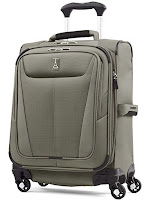
Soft-sided carry-on spinner

one main compartment luggage
Image credit: Amazon.com
For the trips where I know we'll be traversing flat, smooth surfaces, my primary piece of luggage, is a soft-sided, expandable, 4-wheeled "spinner" that is the exact dimensions of the maximum size quoted by Air Canada for their standard article carry-on allowance. It has one large main compartment, with two smaller flat zipped areas on the front. I prefer this style vs. hard-sided spinner, as with the latter, you must fully open the case in order to add or remove anything from it, sometimes even unzipping a secondary partition to access the contents. The clamshell design also requires twice the space to fully access the contents, which can be an issue in smaller European hotel rooms. With the single compartment of mine, it fits nicely on the hotel's luggage rack, or you can open the zipper partially to access small items at the top of the bag, and even put smaller, flat items in the outside pouches. Even when placed in the overhead bin on the plane, you can still access some contents that are near the zipper openings. However, at 3.7 kgs, it's not the lightest piece, despite being touted as "light weight". I'm likely not using this spinner, when we are often going to be moving across town on cobblestone streets; e.g. dragging it across the pedestrian only area of Dubrovnik.

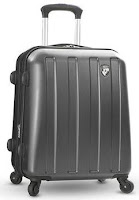
Hard-sided carry-on spinner

clamshell-design hardsided luggage
Image credit: Heys.ca
Her choice is this Heys 21" Latitude WIDEbody, hard-sided, clamshell spinner, also exactly the maximum standard article carry-on allowance. Whereas I find the clamshell design a hindrance, she prefers it; rather than unpacking on overnight stays, she simply opens it up, and slides the whole piece under the bed. With half the contents on each "side", it allows her to grab the item(s) she needs without having to rummage around through layers and layers of clothes. Of course the hardshell design also allows for maximum compression of your clothes; you can literally overstuff it, then sit on it to zip it closed. Hers is only slightly lighter than my primary piece, at 3.4 kgs. For the shoulder seasons, where we end up with a bit more cool weather clothing, we switch her 21" Heys out for the 26" one, and I stay with my 21"; this is more than enough for the two of us for everything except a Swiss Alps ski vacation.

Personal article

Necessities that I like in my personal item
Too. Much. Stuff.
Update: I used to travel with a mirrorless Canon camera, and one or two lenses, but recently upgraded my iPhone to a Pro model, and think that will be my only camera when travelling going forward. But I still tend to bring along a lot of kit with me, regardless of destination; usually an iPad, iPhone, noise-cancelling headphones, small bluetooth speaker and all of the associated cables and chargers for each. I put what I think I'll need during the flight in my personal item, not only for ease of access on the plane, but also just in case I need to check my bag at the gate - which does sometimes happens when the plane is totally full.

If I need to maximize my carry capacity, I take advantage of the full personal article size allowed by the airline, and bring this backpack I received from Emerald Waterways as a pre-cruise gift. It holds all of the aforementioned kit, and also has room for some snacks, a bottle of water, and a sweater or packable jacket. It has a few neat pockets for easy access to passport wallet, pen, sunglasses, etc., so it can 
double as a daypack when we arrive at our destination. I like that it holds its shape, even when not fully loaded, and doesn't have a lot of extra straps and buckles. For trips where I don't need as much storage or when I am using the Osprey backpack, I switch to a Travelon crossbody bag for my personal item, that doubles as my day bag (man-purse) while I'm out touring. With a unisex design, this model has lots of security features that my old man purse didn't have.

Her choice for personal item
Image credit: pacsafe.com
She used to like this ultra-lightweight convertible daypack from pacsafe; it had just enough space for her essential items while on the plane, and is great for day use while touring around town as well. It is very thin nylon, but has a cut-proof pouch on the inside, so that would-be thieves cannot slice into that portion and make off with cash or valuables in there. As a bonus, it all folds neatly into the small internal pouch when not in use, so you can have it with you about town if you purchase something, or want to put your sweater or jacket away. Edit: When she's since gone with a Travelon anti-theft crossbody bag as well.

Finally, since we typically pack so that every nook and cranny is used up, we both have one of these lightweight, reusable shopping bags, which in pinch, can double as a tote bag. They take up almost no space, and help bring back your souvenirs or duty free purchases. At the very least, you can use them for grabbing some fresh fruit or beer from the local market. If necessary, it becomes one of your carry-on bags, and we can just check one of our spinners; going home, there is less concern about luggage going missing. 

Regardless of what you decide is the right combination of luggage for your travels, make sure you keep it simple, and pack light! As a good friend of mine who travels almost weekly once told me, "what you don't have, you can always buy".

No endorsements or fees were received for this post.

Tuesday, May 28, 2019

Konnected alarm system

Technology and Gadgets

$22 a month. That's $264 a year. That's how much I pay for the monitoring of my existing home alarm system. But we don't "arm" our system very often, because we have one of these:

Bernese Mountain Dog on duty
I know, he doesn't look very intimidating - but at ~60 kgs., he's got a really deep, impressive bark. Walk up to our back gate at night sometime, and you'll hear it, that's for sure. And at night, you can't see that he's a fluffy cuddle bear - for all you know, he could be a Rottweiler, ready to rip your throat out.

But in actuality, there's probably only 2 weeks a year where we actually arm our system - now that works out to $132/week of monitoring while we are vacationing somewhere out of town. Being Scottish (i.e. cheap), I have long felt that this was too much money to be paying for services that we don't really use. We live in a pretty good neighbourhood, and we've never had a break-in attempt since we moved here in 2005. Besides, did you know that most alarm companies don't even call the police? Yes, the first thing they do if your alarm goes off, is they call people on your contact list. If they reach someone, then they have the ability to request a police dispatch. Elapsed time for all this to occur? Probably 15 minutes - trust me, I've been the guy who got called when a friend's system got tripped. The perpetrator had loads of time to gather a few valuables and had slipped out the back long before the police and I arrived.

Brinks ADT legacy alarm board
Old alarm panel (note missing common wire for zones 1-4)
Enter Konnected. In truth, it's been a few years where I have thought about doing something about our alarm system. But each time I looked into it, there was some tech issue preventing me from moving further. A month ago, I saw something on TV, and when I searched for converting existing alarm systems to Wi-Fi monitoring, Konnected appeared at the top of the search. It looked pretty easy online, and I'm pretty handy with the DIY stuff, if I do say so myself. After ensuring my system could be replaced (virtually any wired alarm system can), a bit of Googling and research, I bit the bullet, and ordered the Konnected panel. I also ordered the Samsung SmartThings hub, as it seemed to be easy to set up, per the instructional videos.

Konnected WiFi enabled alarm system replacement
Konnected board installed (with much simpler wiring!)
Setup was mostly as Nate describes in the installation video. But one hitch for me, was that my old alarm system installer used a common ground with four of my wired devices. Not a huge issue, except that my siren/speaker is one of those four devices, along with a motion sensor. See, the motion sensor needs aux power, and therefore must share the common ground with the siren. But for the Konnected siren circuit, they have adopted an unconventional, reverse voltage state deployment. i.e. There is +12v on the negative pole of the alarm terminal in the siren off state; when triggered to on, the pole goes to 0v, thereby sounding the siren. My fix for this was to remove and re-install the siren in a new location, allowing me to re-wire with two conductors, and connecting to the Konnected board as instructed. The problem then, was that my siren was just a dumb speaker, so I had to order an actual siren, as the speaker needs a siren driver. With a small jumper wire bridging the zone 1-2 common to the one for zone 3-4, all of my sensors are working properly. I added a SmartThings wireless sensor for my garage door, as it was not part of my old system. Another thing I added, is a leak sensor, which is a good idea if you have your own hot water tank. Now using the SmartThings hub and the associated iOS, I can monitor and control my security system anywhere!

SmartThings home automation app ios
Total costs were as follows:
  1. Konnected panel kit $89 USD
  2. Samsung SmartThings hub $80
  3. Honeywell siren $30
  4. SmartThings wireless contact sensor $24
  5. SmartThings water leak sensor $24
  6. Ikea Tradfri Zigbee repeater $10
I found that removing the old system (incl. the metal housing), attaching a plywood panel, and labelling and cleaning up the wiring took the majority of the time. I followed the step-by-step instructions on the Konnected.io site exactly, and had no surprises (except the siren issue, which was specific to my wiring). So for about the same as a year's worth of alarm monitoring, I have a new, smart-home monitoring solution!

Tuesday, April 23, 2019

Simplifying my travel world

Travel Gadget Organization

Now that I've re-joined the business travel world, I need to get re-acquainted with the ins and outs of being a proficient, efficient frequent flyer. Sure, I've still been flying at least a couple of times a year; at least once for vacation, and maybe one annual business trip. However, on my most recent flight, I managed to get tripped up at US customs (forgot to update my Nexus info - doh!), and while fishing out my passport from my messenger bag, I snagged a loose cable and it pulled out a bunch of little things onto the floor in the security screening area. I felt like such a rookie!

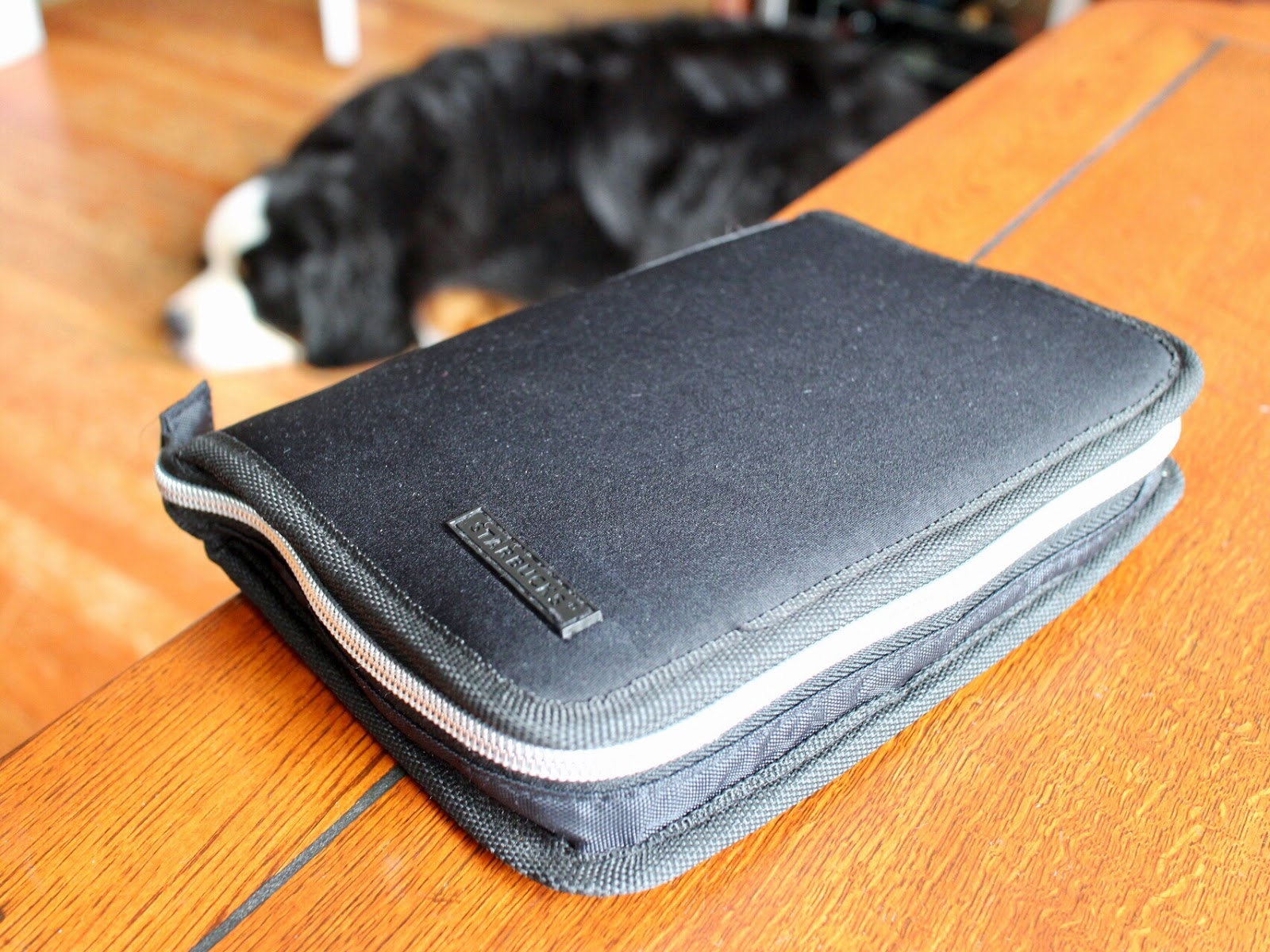
Recently, while waiting in line at Starbucks for my morning caffeination, I saw something shiny in the sale bin (turns out it was the zipper). I didn't know what the item was, but it had already found its way into my curious hands. Of all things, it turned out to be a travel office organizer - a place to keep your miscellaneous cables and items neatly stowed while you are dealing with the adversities of business travel. It has the elastic straps like the GRID-IT! systems, but it zips closed, keeping everything neat and tidy.

travel gadget cable device organizer with zipper and gridit style
It holds virtually all the things I/we need when travelling abroad. I have another Cocoon GRID-IT! that has some other things that we don't use as often, and it slips into my larger suitcase if needed. Here are the essentials, that in my opinion, work well for two people that have two devices each.
  • Bose SoundLink Micro bluetooth speaker
    A travel must for playing music from your iPhone or watching a movie on the iPad, the sound from this tiny speaker is nothing short of remarkable. Edit: When I need to save weight, this stays behind. If I'm not taking it, I put all the stuff in an even smaller little bag.
  • USB power bank
    You use your iPhone lots more when travelling, whether taking pictures, using Maps to navigate, or searching for the next place to eat; don't end up stranded without power! I recently upgraded to a 5000 mAh one (flat red device pictured) as it will give at least one full charge for my iPhone 12 Pro. Get one that has more capacity than you need makes it heavy, and more likely that you won't bring it along every day.
  • Multi-port USB charger
    Rather than bringing a charger for each device, get yourself a multi-port charger, like the Qualcomm triple port one, pictured. Newer ones are available with USB type C ports. Make sure it has enough oomph to support charging an iPad and iPhone simultaneously. 
  • Short USB power cords
    These are easy to find at the dollar store, online or sometimes devices come with short versions; you don't need long cables for charging, so why bring them? I do bring one other longer Lightning cord, just in case you need to use your iPad/iPhone while replenishing the battery. Plus, I need two Lightning cords if I want to charge both my iPad and iPhone simultaneously. Edit: I found this 3-way USB charge cable, and have added this instead; it allows me to charge 3 devices off one port.
  • Travel adapters
    Most places we go in Europe can be handled with these simple two-prong, round pin adapters. Since pretty much all chargers for electronics are already dual-voltage, you only need to convert the North American prongs to the local outlet style. I bring at least two, as sometimes you can use the shaver outlet directly for other devices.
  • Right-angle headphone adapters
    I often use my own headphones on the airplane, but sometimes the 4-pole mini-plug (because there's a microphone pole) screws up the 3-pole connection in the armrest socket. These handy little things are only a dollar or two on eBay, and work to both prevent audio connection issues, and inadvertent bending or breaking your headphone connector (more on that in another post).
I usually tuck this organiser into my checked or overhead bin luggage, as I don't normally need these items (except the headphone adapter) on the flight. I reserve the space in my personal carry-on item for things like food/snack items, noise-cancelling headphones, and iPad; that way there's always space to stuff my (bulkier) jacket or sweater in once we've completed boarding.

Originally published Sept/2012

Tuesday, March 26, 2019

This must be phase 4...

Retirement Life

Since I'm now entering my third year working (barely) in the TV and film industry as an extra, I guess I'm now officially entering Phase 4 of "The Four Phases of Retirement" - Reinvent and Repurpose. When I started doing this "background" work (called BG in the industry), I thought to myself, "I'll give this a try, and if I get bored, I'll just stop doing it.". Admittedly, there has been some other engagements that I have booked through my Principal agent for commercials, video shoots and still photo modelling, but most of what I've been doing for the last two years has been BG.

Playing a doctor on Supergirl screenshot
"I'm not a doctor, but I play one on TV" (Supergirl)
As mentioned in the previous post, there are days of paralytic boredom... sometimes 5 or 6 hours of waiting around before you even get to set. But after a while, you get to meet some great people, and look forward to those BG bookings where you have lots of friends there to help you while away the time. There are also lots of funny things that happen on set, especially when you have fun actors and/or directors around.

Kevin Smith guest director on Supergirl handing out Timbits between takes
Like the day that Kevin Smith was the guest director on an episode of Supergirl; to keep us entertained, he walked through the BG crowd between takes, with boxes of Timbits. And while I'm not the kind of guy that gets star-struck, it is pretty neat working on a set where you are standing next to some Hollywood A-listers. But after a while, the novelty of standing next to Jessica Biel for a couple of hours does kinda wear off.

Closeup on Salvation season 2 premiere where the world learns about the asteroid
Closeup on "Salvation" when the world learns about the asteroid 
The other fun thing about doing BG, is pretending to be someone else. I was booked on a show called Salvation as a Colonel in the US Marines; it was a "continuity" role, so each day, I showed up to put on my uniform so that I could walk the halls of the Pentagon, or sit at a briefing in the Oval Office. Not something everyone gets to do in their day-to-day job, that's for sure.


Probably the most fun so far in this "Reinvent and Repurpose" phase of retirement, was a commercial gig I booked for the Rocky Mountaineer (you can read more about it here). It's a train trip that takes you from Vancouver, through Southern BC, and winds its way to the Rockies, ending in Jasper, Alberta. It was two days of "work", which entailed riding on a beautiful train, through amazing scenery, and pretending to eat and drink throughout.

At the end of 2018, I summarised my reinvention stage with:

56 days on set
• 455 hours as an extra
• 15 TV shows
• 4 feature films
• 1 movie of the week
• 2 zombie encounters
• 4 days in the White House
• 1 promotion to ‘full bird’ Colonel
• 6 meetings with the President (not that one)
• 2 nuclear crises averted
• 32 auditions
• 9 callbacks
• 3 commercial gigs
• 1 lead role
• 2 photo shoots
• 21 assorted pastries
• 2 dozen doughnuts
• 23 books read
• 8 Netflix shows watched
• 3 nights in Whistler (thanks Jeff!)
• 2,039 kms auto
• 3 train trips (one real, two on-set)
• 2 plane trips (one real, one on-set)
• 1 visit to the North Pole

 Anyhow, I think it is safe to say that I have officially been repurposed.

Wednesday, August 29, 2018

Entering phase 3

Retirement Life

It's early 2017. A full year since retirement, and Vacation Time has been fun. But in the winter, it's too cold in my garage to do woodworking, so I started thinking about, "what else can I do"? I did a bit of trolling on some job sites, using search words like, "occasional" and "temporary". I even reached out to a friend who does brand work, to see if they needed anyone to help out once in a while. I quickly realized that while I had marketable skills, the ad hoc level of work that I was willing to do was simply too ground level for me. e.g. manning a registration desk at a conference was not something I was ready to put myself through.

So a couple of months later, I'm at a cocktail party, and run into an old friend. Talk quickly turns to what I'm up to, and after finding out that I'm retired, she says, "you should be auditioning for commercials!". Yeah right. That's like being a real actor. I suggest that I might be up for something a little more basic, like extra work. So she referred me to a friend who runs a background (BG) agency. I sign up, get some photos taken, and literally a couple of weeks later, I'm on Supergirl!

First appearance on a TV show as an extra with Melissa Benoist as Supergirl
What the heck?!? Yes, on my first day as a BG, I was pulled into two scenes where I either sat next to, or interacted directly with the actors. What a trip! Ok, so it's not a show that I would normally watch, and the acting is, well, not that great. But for a former IT professional, this is a significant departure from my daily activities.

Ok, truth be told, there is a ton of sitting around, waiting in an area called background holding. You receive a call time the night before with some wardrobe instructions, and after you check in with the background wrangler(s) and sign some paperwork, you get processed by wardrobe; this usually means having the costumer look you over, and if necessary, have you change into something different. Then you go through the hair and makeup department, and then you wait. And wait. Sometimes, the wrangler will keep you informed of what is happening on-set, sometimes you have no idea what is happening. But you meet other BGs, and often strike up conversation about other shows or BG activities.

After what might have been a couple of hours, or sometimes half a day, you get called to set. The BGs stand off to the side, and an Assistant Director, or sometimes one of the wranglers will give you instructions on what to do when they call for action. For the most part, you really just behave normally, except that you have to mime conversation. Whatever action you are performing, walking down the street, sitting in an audience, or being a doctor in a hospital, you do the same thing for each take. They change the camera angle three or four times, so you might have to do the action again, or if you end up behind the camera or some rigging, you get relaxed back to holding.

My first couple of days on set were very long - 15 hours! You get fed throughout the day, and there is always a table or tent set up with Craft Services, which we call Crafty for short. I made sure that I brought a book, as there can be long stretches with no activity. Will this be a regular thing for me? Let's find out.

Thursday, August 23, 2018

Working towards phase 3

Retirement Life

I spent the better part of a year in "Vacation Time", the first phase of retirement. I didn't spend the entire time doing woodworking, as I also used some of my new free time to fix up all of those niggly little things on my 1967 Mercedes 250SL roadster. I bought it back in 1998 or 99, just a bit before the dot com crash... a good idea in retrospect, otherwise my investment would have turned into a significant loss.

1967 Mercedes-Benz 250SL roadster
Anyhow, it didn't need much work really, but I had been noticing that the value on hagerty.com had been climbing substantially, and since it was mostly collecting dust, I decided it was time to sell it. I ended up doing most of the little things on my own, and then had one minor spot of rust taken care of at the body shop. Three days after listing it on craigslist, I sold my little baby.

Later that year, we decided it was time to get another dog, a Bernese Mountain dog, to be precise. I immediately reached out to the breeder who we got our first one from, and she indicated that she had yearling that had been returned. His name is Buddy, and he had more energy and size than the original owners could handle, so he became my new retirement Buddy.

2-yr old Bernese Mountain Dog named Buddy