Friday, October 29, 2010

"Some of us were not meant to be soldiers..."

Corporate Life

Long time no post. I'll admit that now that this blog is in the public domain, it concerns me somewhat that my ramblings can or could be misconstrued, and perhaps have a ripple effect that I did not intend. But alas, one cannot remain silent forever.

Recently, we made some organizational changes, and as is inevitable with all of these kinds of cultural transitions, some folks "went home". The funny thing is, that everyone talks about the individuals that are/were involved - hoping, indeed praying - that management will see their way through to making the changes for the better good of the company. But when change is actually executed, people say, "oh, that's too bad... ", or "they would have been able to come around eventually". Sure, no one wants to see anyone experience personal hardship or suffer from the emotional turmoil caused by a rapid departure. But deep down, everyone knows it's the right thing to do. But if there was more at stake than winning a deal, or getting a commission cheque, would we be so sympathetic?
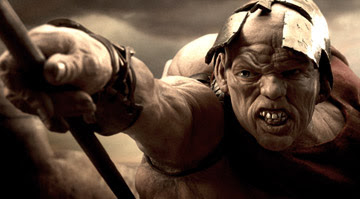
Spartan battle of Trachis
Ephilates, demonstrating his thrust technique to Leonidas

Take King Leonidas - the famous Spartan who led 300 of his men at the Battle of Thermopylae. On the eve of battle, he is confronted by Ephialtes of Trachis, a hunchback who would like nothing other than to serve (and die) as a Spartan. While Ephialtes has the heart of a warrior, and quite probably could hold his own in individual combat, he lacks the physical ability to augment and protect the team. Leonidas explains that the phalanx is the source of the Spartan strength; a single weak spot in the formation, and the phalanx shatters. Since Ephialtes is unable to raise his shield over his head, he cannot protect the Spartan next to him, and essentially becomes a liability to the entire unit. While Leonidas is sympathetic to Ephialtes' will to fight, he must let him go; if he were to allow Ephialtes into his infantry, he puts everyone at risk.

Ok, so no one is going to be killed by the invading Persians in a business environment, but these days, we all have far few resources, time and energy to put into questioning or apologizing for the changes that we need to make to be successful. Sometimes, we need to simply accept that there are those that we can't afford to have on the team when their abilities or negative energies detract from the strength of the overall unit.

Oh, and in the legend of the 300 Spartans, Ephialtes seeks revenge for being spurned by Leonidas, and shows the Persians a secret path to attack the Spartans from behind. The Spartans are surrounded and everyone is massacred. Let's hope legend doesn't hold true in this case.

Thursday, March 26, 2009

Being comfortable in your own personal universe

Corporate Life

In a previous blog, I spoke about some introspective thoughts that "Shane" gave me. My parting thought was about finding the right team, and getting them to stay put long enough to extract value for the customer and the company. But at the same time, we've got to keep their career interests at mind, right? But promoting someone for the sake of promotion doesn't always work either. Some of the worst managers I can think of were great sales reps at one time. No, Shane's advice was to find the guy that is happy to play their position.
comfortable leather lounge chairOk, his perspective requires a bit more explanation. There's people out there that where their "personal universe" (that's my term for it) only extends to limit of their skill/capabilities. There's also folks out there, where they can see further into their universe than their CV can take them - i.e. they have higher aspirations than they should. In Shane's line of business, his challenge is to find someone who is very capable of controlling a $200M company, but isn't going to get a bruised ego when Shane comes into town, shuffles things around, and then leaves. No, Shane's ideal candidate is the guy that can stay within the confines of his universe, and be happy in it.

This train of thought doesn't mean that we should be putting blinders on the folks on our respective teams, but it does imply a level of complacency. I'm not talking about the ones at this company that are already semi-retired (you know what I'm talking about, and likely even know a few of them). No, I mean the ones who can do a great job, and yet don't feel constrained by the confines of their personal universe.

I'll give you an example in another business world. A good friend of mine, Kenny, is a plumber - a very successful plumber, mind you. He is so busy, that he finds that there is much more work than he can handle himself. Problem is, how do you find another plumber, that doesn't think, "I can do this on my own - why am I only getting a salary from this guy?". But he did manage to find another plumber (Ben) who is happy to drive the second van, do the work, but doesn't aspire to have his own plumbing company. Kenny got a very competent professional, that can independently handle work, and he doesn't have to micro-manage him, and is not concerned that in 6 months that he will jump ship for the next job or opportunity; i.e. Ben is comfortable in his own personal universe. If only we had it as easy as Kenny.

Originally Posted on: Feb 03, 2008

Monday, March 2, 2009

Pick your {insert role} carefully

snow houses It snowed again today in Vancouver. I say again, because it doesn't usually snow often here (maybe once or twice every couple of years), but this is probably our fifth snowfall this year. When it does snow however, it brings the Lower Mainland to its knees. Schools close, highways turn into parking lots, and business comes to a crippling halt. But the wonders of internet technology, SSL connections and VPN clients allow us to work from the comforts of home, without having to brave the elements. Ok, so maybe a quick trip to Starbucks is allowed. As I get caught up on e-mail, I thought I'd use the solitude of my home office to get back on the blog.

I spent a couple of days this weekend up at Whistler skiing with a business associate (let's call him "Shane") - let's just say that that this guy is so successful, that it makes my job pale by comparison. His base salary as CEO is probably over $500k/year, and his business endeavours look to double his company's investment in a year. Double. Buy a company for something less than 2x revenues, refresh the management structure and strategy, then sell it a couple of years later for double. I can't even imagine what the commission/bonus is on that.

I'm not going through this to depress you. But when you spend time with someone who has this kind of perspective, it makes the "multi-threaded performance of an UltraSPARC T1 vs. T2" seem a little insignificant. Needless to say, he had lots of insightful management thoughts and sound bites.

One of the best ones Shane said was, "Don't work for someone who has done the job before you - you'll never live up to the expectations they have". Brilliant. It may not always work out that you can pick a position where your manager hasn't been in that role, but it certainly makes sense. You could do everything perfectly, and even over-achieve your target, but if you aren't doing what he/she did when they had the job, you're probably not doing enough.

It's kind of a different spin on ex-CEO Jonathan Schwartz's advice, "Pick your managers carefully". That was the advice he gave us last time we saw him in Menlo, when someone asked what suggestions would you have for new managers at the company. My own philosophy on this, is to pick the right people for direct reports - you hire smart people for your team, and you'll be successful. But there's a tricky balance of having a person who is competent yet content to stay in their role for a while. We all want our folks to be successful too, but that might mean staying put long enough to drive value for the company... too much movement creates chaos. Remember that we're trying to reverse entropy here, right?

Originally Posted on: Jan 29, 2008

Monday, February 16, 2009

Change comes fast

Corporate Life

Let's face it, no one likes change. But hey, this huge world around us is in a constant state of flux, and as the theme of this blog suggests, you need to do something about it eventually, or you'll be faced with an ever increasing mound of chaos.

ice age cavemanBut change, and being able to react and adapt to change, has become one of the most important things these days. Sure, a long time ago, you might have been able to go an entire lifetime without ever having to change. You would have gotten up in the morning, tightened up your loincloth, grabbed your spear, and gone out looking for something to kill with the rest of the boys. Next morning, same thing. Following morning, same thing. And then one day, you either didn't wake up (unlikely), or one of those edible things that you were trying to kill, put you on the dinner menu instead (more likely). However, many, many generations later, it got cold, and the hunting went for crap, so your offspring had to follow the herds South in order to feed the family and keep from freezing to death. But there were probably some that resisted the move - too stubborn, too old, or too slow to react - and those knuckle-draggers paid for their obstinacy with their lives.

Today, those external forces that require us to make change come at us much more frequently, and from so many more angles. As I had written about before, technology brings issues and challenges to us faster, but it also allows us to react more quickly to them. As an example, I went looking for something today that might have taken weeks to find out or confirm through our competitive analysis team, but instead uncovered the answer in a matter of minutes with a quick Google search. Rather than wait for someone to present me the data, or get in queue for an answer that might never have come, I chose to act instead. Was it my job to become a competitive analyst? Probably not. But to exceed the ever-increasing goals set out for each of us, we need to find new ways to adapt and react. We all have to do more with less, and do jobs that were previously outside our scope of work. If we were all to let our past behaviour dictate our future actions, we will surely fail.

End result? We all have to move at a pace of change that we previously thought was not possible, or risk being left behind in the cold.

Tuesday, January 6, 2009

Chance favours only the prepared mind

Corporate Life

BC earthquake occurrencesWe had two big earthquakes near here recently; a 6.4 and 6.5 on January 5th, about 200 kms off the coast of Bella Bella, BC. It didn't cause any tsunamis here in Vancouver - even if it did, I live at about 65 metres above sea level, near one of the highest points in Vancouver proper - Queen Elizabeth Park, at around 125 metres. It's also a big, stable area - an ex-rock quarry actually. So while the folks in Richmond will have their land turn into a quicksand-like slurry when the big one hits, I'll be running for the safety of Queen E. Park.

Anyhow, while I was researching the two earthquakes, I came across a website that indicates that we have a few earthquakes near Vancouver pretty much every day. In fact, we are overdue for a big one - not a weenie shaker like the ones caused by the San Andreas Fault, but a geography-changing, tsunami-causing, subduction earthquake that will cause substantial loss of life and general chaos.

It usually takes an event like this for the news to pipe up about earthquake/disaster preparedness, and all sorts of articles come up about how would you get by if there were no electricity, food or drinking water. It actually even comes up when we get gobs of rain in a short period of time, and our water reservoirs on the North Shore experience "high turbidity" when clay, silt, organic matter and illness-causing giardia, cryptosporidium, bacteria and viruses are washed into the watershed.

Back when hurricane Katrina hit, the Vancouver Sun ran a feature on the kits you should have for disaster preparedness, and I kept it, intending to put together a kit on my own. Well here we are, over two years later, and I finally got around to putting it together. Most of the stuff I had already - little things that I've collected from years of camping and a couple of small duffel bags that we weren't using. I just need to add some water and non-perishable food, and we're now prepared for whatever might happen.

DIY get out of town bags
It was Louis Pasteur that said, "... chance favors only the prepared mind". But before you start thinking that I'm some scholar that followed the careers of famous scientists, I first heard the quote watching a Steven Seagal movie, when the bad guy, Travis Dane blurted it out. Just one more reason to watch crappy, B-grade action movies.

Originally Posted on: Jan 14, 2008

Sunday, December 14, 2008

Things you can learn from Steven Segal

Corporate Life

I know, I know. Horrible actor. Hollywood kung-fu. Runs like a girl. But every once in a while, there is a little gem hidden in one of his piece-of-crap films (not to mention that there is always some B-grade hottie trying to move up from Baywatch to the big screen). Anyhow, let me set the stage for this one.

So Casey Ryback (Steven Seagal) just happens to be on the same train that a bunch of mercenaries hijack and are going to use as the moving headquarters to commandeer a top-secret Government satellite to blow up the Pentagon for some middle-eastern terrorists. There's a bad guy, Travis Dane, that sends some thugs off to kill Ryback. They shoot him, and think they see him fall off the train, so they report back to Dane that Ryback is dead. Dane is unconvinced, and asks if they actually saw the dead body, or if they just assumed he was dead, because "assumption is the mother of all fuck ups". Needless to say, Ryback wasn't dead, managed to stop the terrorist plot, and killed Dane in a flurry of kung-fu blows and meat cleaver-wielding chops (Ryback is supposed to be a chef!).

So why is this relevant on corporate blog? Well, it's coming up on the end of December, and we're all in a mad panic to book orders in time to ship for quarter end. I don't know how many times I've come across situations in the last week or two where we'd have saved countless hours of work and many grey hairs, if we hadn't assumed anything. "They said they had everything in order, so I assumed everything was ok". "Everyone knows how important this deal is, so I assumed they would expedite it". "I'm part of the sales team, so I assumed that I would get credit for the deal just like everyone else". Wrong, wrong, wrong. If you really want to make sure things get done, you can't assume anything, because...
assumption is the mother of all fuck ups.

Originally Posted on: Dec 17, 2007

A better apple crisp recipe?

Corporate Life

Another commonly held misconception is that the belief of a flat earth was nullified when Columbus sailed across the Atlantic Ocean. In fact, the notion of a spherical earth has been around since Late Antiquity (c. AD 300 - 600), but it was Washington Irving's book, The Life and Voyages of Christopher Columbus published in 1828 that propagated the notion that superstitious sailors believed they would sail off the end of the earth. However, it is simply enough to know that there was a time, when the only earth was a flat one. Why would you think anything else? Round? Come on. The oceans would drain off, right? But eventually, people came around to the theory of a spherical earth, and now, except for a few radicals, you'd be crazy to think otherwise.

But the earth was still the centre of the universe, right? I mean, the sun revolved around the earth, after all. The Greeks believed it... the Catholic church endorsed it... why believe anything to the contrary? You would have to be an idiot to think anything different. But a guy named Nicolaus Copernicus came up with a theory that the earth actually was the one revolving around the sun, and not the other way around. Then our man Galileo proved him right. So for thousands of years, we all thought that we were certain of what we knew, and guess what? We were wrong. Somebody else knew what was right, and eventually, we came around to their way of thinking. It probably wasn't easy, but over time, we began to realize that we didn't know everything, or we weren't always right. And the guy that came up with it? Well, it turns out he wasn't an idiot after all. So perhaps that co-worker has a better way of doing it than you do, and he isn't a complete imbecile for thinking that he does. And it is possible that the customer could be right, despite the fact that everything tells you that he is most likely wrong. Or maybe, just maybe, someone else has a better recipe for apple crisp.
Ma Chin's famous apple crisp
A longtime staple of the Chin diet, this crisp doesn't include oats, as most recipes do. Instead, the shortbread-style topping makes this dessert unique.

Ingredients:
6 medium apples - peeled, cored and sliced
1/4 c. white sugar
2 tbl. white flour
1/2 tsp. cinnamon
dash nutmeg

Topping:
1/2 c. butter
1 c. white flour
3/4 cup white sugar
dash salt

  1. Pre-heat oven to 400° F. Butter/grease medium/large baking dish.
  2. Place apples, sugar, flour, cinnamon and nutmeg in dish and toss to mix ingredients.
  3. In separate bowl, combine topping ingredients and cut in butter until mixture is crumbly.
  4. Spread topping mix over apples and pat down lightly.
  5. Bake covered 15 mins at 400° F; reduce heat to 325° F for 30 mins uncovered. Cook until topping browns lightly.
Serve warm, topped with whipping cream or vanilla ice cream.
Orignally Posted on: Nov 13, 2007