Friday, March 27, 2020

Surviving the pandemic

Organisation

How prepared have you been for this COVID-19 pandemic? Were you caught flat-footed, with bare pantry shelves? Or were you ready with your N95 masks, gallons of hand sanitizer, and a year's worth of MREs? In most respects, this global crisis is much less severe than other bad things like an ELE (Extinction Level Event) meteor strike, or nuclear war with the accompanying nuclear winter that would follow. As such, "preparedness" really has a different reality in this situation - you probably don't need to be able to mill your own flour, or start growing your own veggies to survive this. Getting through this is going to require minimizing contact with others and practicing extremely good hygiene - which is why we're in this Social Distancing mode. In retrospect, I did not have this on my list of things that I would need to be prepared for in a crisis situation - i.e. do we have enough supplies to quarantine for two weeks?

We're about two weeks into our own government-requested, self-imposed isolation. Neither of us are sick, nor have we been in contact with any confirmed cases, but we are doing our best to minimize the spread within our circle of family and friends, and in our community. I don't think we are "preppers", but we have some level of emergency preparedness that probably exceeds the average person. For example, we had created our own emergency kits for use in case of other disasters, such as earthquake, tsunami, etc. And because we have a separate, unused basement suite, we typically have a fair bit of non-perishables and frozen food stored down there, as well as supplies of paper towels, Kleenex, toilet paper, etc. Admittedly, some of these things are really required for disasters worse than this pandemic, where things like vacating our home, and/or leaving the area are required. e.g. "shelter in place" is certainly a lot different than the folks that had to vacate quickly due to flood, or worse, in a matter of minutes because of an approaching wildfire.

Costco lineup!
So when I saw this coming, I think we were somewhat prepared for the "stay home" order that I knew was imminent, but had yet to come. However, due to an unplanned trip to see my elderly parents, I was unable to take the last few steps to stock up on the few items that we had not recently replenished (no, not toilet paper). As such, when I got back and needed to get some dog food at Costco, I was faced with the horde of people frantically trying to get their hands on toilet paper and hand sanitizer. This was my first real experience with what happens when the media whips people into a frenzy, and rational thinking quickly gets pushed aside. Grocery stores too, were getting cleaned out, and in less than a week, they were imposing limits on most products, and enforcing social distancing measures.

Ketchup supply dwindling
We are doing well from a supply perspective; there are a few things that we are running low on now (milk, ketchup, fruit, etc.), but they'll get added to the grocery list, and we'll be able to get them next week. But while I was out cleaning the garage (what else does one do while staying home?), I noticed that one of my emergency bags was growing mould on the bottom! Upon closer inspection, it turns out that a can of peaches failed, causing the mess on one side of the bag - yuck! A quick Google informed me that while canned goods normally can last years, certain products can cause the cans to swell and fail before you end up using them. As such, I'm going to start eating up these canned items, and will eventually replace them with new ones once this pandemic passes.

Reasonable success at Walmart
How have we done so far then? If this were the zombie apocalypse, I'd say we'd have scored 6/10. We didn't have adequate supply of key items that would have augmented our 'grab-n-go' bags, one kit was a mess, and drinking water had not been refreshed recently. But with this stay at home order, it's much different - there's no issue with water, electricity, gas and the all-important internet. So rating our preparedness is a bit different, as the things that I feel are important revolve more around how many times you need to go out to get items that are running low/critical. We could have done better at keeping our non-perishables stocked, and when the infected cases started to rise, I should have gone out to re-supply earlier. We have N95 masks in our emergency kits, but we haven't used them (yet). We had disinfecting wipes on hand, but our bottles of sanitizer were almost empty, and required re-filling. You can't do much with respect to perishables like fruit and veggies, but we could have had some more canned or frozen ones on hand. My assessment? Based on our current supply situation, I'd say we're at a 9/10, but two weeks ago, we would have only been 7/10. I think 10/10 would have been a lofty goal, and really, not a practical one, as you'd have to have things like jugs of milk in your freezer, and a fully-stocked root cellar.

Friday, January 17, 2020

Avoiding travel mistakes - Part 2

Travel and Leisure

On safari in Zimbabwe
As I had mentioned in the last post, I've travelled to quite a few states in the US, Central America, the Caribbean, many European countries, and even down to West Africa and Zimbabwe. For the most part, my trips have been relatively issue-free, but I have had some bumps along the way, and learned a few lessons from them. So continuing on with my list, again with in no particular order of importance.

Download apps and files at home

Unless you have a great international roaming plan for your smart phone or device, you don't want to rely on the Wi-Fi at your international hotel to get that critical travel app. And you certainly don't want to try streaming Netflix over that connection either, so you'll want to download movies and shows before you leave home. Of course you can get a SIM card when you arrive at your destination, often for only €10 or so, and use the LTE data. But one time in Rome, I managed to use up my allotted data entitlement in a matter of minutes, by downloading an audio touring app for my iPhone, and a bunch of free walking tours. Luckily, the Wi-Fi at the bed and breakfast we were staying at was very good, so we weren't too inconvenienced by it.

Check for local/regional affairs and issues

While it's not always obvious to travellers what could be happening at your destination, it is a good idea to ask a local or check the news as to anything that might be pose a challenge. Things like local holidays or celebrations might want you to re-think your itinerary so that you don't end up in a small town with all of the shops and restaurants closed up. Or like the time in Rome, when we left a visit to Ostia Antica to our last day, only to arrive at the Metro station and find that a rotating transit strike was affecting that one route! It would have been a very inexpensive day trip by Metro, but with an expensive taxi ride as pretty much our only option left to get there, we ended up staying in Rome instead (which is never really a bad thing). Had we known that they publish the rotating strike and which routes were closed, we could have avoided this issue entirely however.

Do some pre-navigation before you arrive

Unless you are taking a taxi from the airport to your hotel, this one might help save some anguish for you. Next time you step out of a train or Metro station, have a look around at some of the other travellers. There will be at least a few that are standing there, luggage in hand, with no idea which direction to go. Often, there is a choice as to which side of the tube station to exit from, so there's a 50/50 chance you'll get it right. Trust me, we've walked a couple of blocks in the wrong direction numerous times, before the blue dot showed us moving the wrong way. But with the advent of Google Maps' street view, it's brilliantly simple to "virtually navigate" to your destination. A long time ago, prior to the advent of smart phones and GPS, we stepped off the bus in Toledo (Spain, not Ohio), and we both looked at each other, "which way now?". We spent the next hour or so, in the mid-day heat, wandering the maze of streets, searching for our little boutique hotel. She laughs about it now, but it was not a fun experience for me.

So on a recent visit to Brussels, I had a look on Google Maps as to where our hotel was w.r.t. the Brussels-Centraal Station. The walking directions showed a semi-circular building that we should see when we exited the station, so I clicked on the Street View to see a preview of what we should look for. When we got there, and walked out of the station, and she said, "Which way?" - I knew exactly where to go.

Use the bathroom when you can

Or as my friend likes to say, "Never pass up the opportunity to pee". You'd think this one would be obvious, right? Especially when you are not sure where and when the opportunity for a bathroom break will occur. But sometimes, you body doesn't seem to have the urge, and you pass on using the WC. Like the time when I was working at the Canadian Embassy in Mexico City. On Friday afternoons, there is a social hour at the end of the day, where they serve tamales and cervezas. But after having a few beers, it was time to head to the airport. Well you can guess what happens next. Rush hour in Mexico City is like nothing you've ever seen before. By the time we got to the airport, I was as close to peeing my pants as I have ever been! Anyhow, if you do end up getting caught with a full bladder while out touring in the city, a good place to find relief is a major chain-style hotel - there will always be a restroom in the lobby, typically near the bar or restaurant. It also won't cost you anything to use the loo there, as it will if you go to one of the public restroom facilities.

Carry a water bottle and a snack

Carrying a drink and snack to get you through
I've learned this one from my wife, who has notoriously high metabolism, and needs to snack in-between meals. But the reason why this one shows up on my mistakes list, is that you tend to make bad restaurant decisions when you are hungry. Like the time we were day-touring in Porto, we were all hot and tired, but rather than take our time finding a TripAdvisor-recommended restaurant, we settled on the first place we could find that served food and cold drinks. Needless to say, the meal was definitely not a highlight, which Portuguese meals should be. Being able to reach into your day bag and grabbing some nuts or a piece of fruit can give you that little boost of energy to get you out of the tourist zone, and allow you to find a memorable place to eat. As a general rule, you typically will get a better meal, at a lower price, if you walk about 5-10 mins. away from the busy tourist zone.

Lookup the local restaurant hours and mealtimes

Further to the above tip, the typical dining hours vary significantly by country and locale. Living in large, North American cities, most people expect that you can pretty much get a decent meal, any time of day or night. But trust me, you can't get a worthwhile dinner before 8 pm in Spain, and don't even try during siesta time. This becomes especially important when your body is still operating on Pacific time, but you're looking for something to eat in Budapest. While she would prefer to avoid eating in pubs or bars, sometimes that can be the only option available when you need to eat at 6 pm in Europe. Or the time that we arrived at Kahului airport around 8 pm - by the time we picked up our rental car and drove around to the other side of Maui, all of the restaurants over there were closed! Had we known, we would have had dinner in Kahului, before setting out for Napili.

Know your limits

When I was younger, I thought I was invincible; I didn't bother with things like travel insurance, and didn't think twice about doing virtually any activity that was part of my itinerary. But I had a wake-up call when I blew my achilles tendon while playing tennis in my 30s. All of a sudden, I had a heightened awareness that maybe, just maybe, bad things could happen to me. And I'm not referring to "accidents" that may occur - anyone can get hit by a car crossing the street. No, what I mean by knowing your limits, is figuring out what might just be a little too much for you.

Day 2 Saas-Fee - smiling because I'm not suffering from the altitude
My example was the ski trip with my college mates to Saas-Fee, in the Swiss Alps. The town itself sits at 1,800 metres (5,900 ft), and the Metro Alpin funicular will drop you off a chest-wheezing 3,550 metres (11,647 ft). We flew on the red-eye arriving in Zurich at 6:30 am, immediately took the train to Visp, and the bus to the town dropped us off around 9:30 am. We were on the first lift by 10:30 am, and enjoying our first pint by noon. A few more runs at high altitude, and my head was pounding and spinning as we sat down for lunch at Spielboden. Now I'm not sure if I wouldn't have suffered if I'd done things differently, but I certainly would have taken more steps to stay hydrated while travelling, and perhaps gone a bit easier on the alcohol consumption on Day 1. But I learned a lesson on that trip - I am not (and never was) Superman.

Wednesday, January 15, 2020

Avoiding travel mistakes - Part 1

Travel and Leisure

different countries visited over the years
Looking back on things, I guess I have done a fair amount of travel - both for business as well as vacation. I have one passport with so many stamps, that I consider it a kind of a badge of honour. But with all of the trips I've been on, there were some mishaps, and other calamities avoided. So here, in no particular order, are some of the things I have learned over 30+ years of international travel.

If you have spare time, spare it at the airport

Heathrow airport on a normal day
I'm not talking about an 8-hour layover between flights here. More like, what are you going to do with that extra hour between breakfast and the time you "think" you should be at the airport? There was this one time where we were staying on the outskirts of London, and my travel partner thought we should take the extra time to wander around the local High Street. It wasn't a particularly picturesque suburb, so I nixed that, and we headed to the airport, arriving over 3 hours early. However, when we entered Heathrow's International Terminal, we were immersed in chaos immediately. Turns out that all of the computers were down, and all airlines were having to check in passengers manually. Had we not have arrived early, we would surely have missed our flight home that day.

Select your airline seat ahead of time

This is one that has come to light more these days, as advance seat selection is typically an additional charge now. I mean, we don't worry about it too much on a short, regional flight, but for long-haul ones, it is definitely worthwhile. I'll even go on seatguru.com, and check out which plane and seat layout is being used, before I book flights. Back when I didn't know better, I was unfortunate enough to get the worst seat possible on a 10-hour flight from Frankfurt to Harare, Zimbabwe. I was stuck in the middle seat, rear bulkhead - yes, the seats that don't recline - and to make matters worse, I was sandwiched between two large German men. Needless to say, I spend the extra money now to get decent seats; she likes the front bulkhead just before Premium Economy, as it gives you extra space since there is no seat back in front of you. Sure, the seat is slightly narrower, as the table tray comes out of your armrest, but we're both slim enough that there's no issue. As a bonus, when you pay for early seat selection, you usually get to board ahead of the masses, ensuring that you get some overhead bin space.

Check your passport expiry date

Check your passport expiry date
You've all seen them. The folks at the passport office, that are freaking out, as the clerk informs them that they will have to pay an expedite fee to get their passport renewed in time for their upcoming trip. Well imagine my surprise, while reciting our passport details to the travel agent, and discovering that hers had already expired. Which would not have been a big deal for the European trip coming up in 3 months, except we were leaving for a beach vacation in Mazatlan in a week! Suffice it to say, that counting on government bureaucracy to complete your vacation plans is a nerve-wracking experience that I don't recommend to anyone.

Understand your insurance coverage

When I was younger, I would never had thought about this. But after having to cancel an expensive European river cruise when she came down with the flu the night before our departure, I do now. Luckily, because I had paid for the entire trip on my VISA, we received partial compensation through them. The other half was covered by her employee insurance benefits - a fact we didn't know then, but are certainly aware of now. And it's not just trip cancellation and interruption insurance that you should consider. There's your medical coverage, as well as your home's insurance while you are gone. For example, did you know that most home insurance underwriters won't cover something like water damage from a burst water heater, if you don't have someone either house-sitting or popping by every few days to check in? This happened to my parents, and extensive damage was caused when their pipes froze; because they had a neighbour popping by to check on things, their insurance covered it.

Bring along some local currency

This is particularly important for us Canadians, as we don't have credit cards with low/no international transaction fees. i.e. a typical VISA transaction will charge you 3.5% in addition to a typically uncompetitive exchange rate (Update: I just got a Home Trust VISA which has no foreign transaction fees for European travel). But you can get cash at a bank ATM machine, right? Not necessarily. Recently, on a trip to Portugal, we ran out of Euros, but our Interac cards wouldn't work in every ATM we tried. Luckily, we were able to borrow some from our other travel companions, so not a huge issue, but it could have been. Bear in mind that while many merchants take credit cards, some countries are still more partial to using cash for transactions in restaurants and small market kiosks. Getting some at the airport foreign exchange is not always going to give you a good rate, and chasing down an ATM is usually the last thing you want to do after 12+ hours of travelling. BTW, I find that you can even negotiate a better rate with the teller when you pull up at your local bank branch. Pandemic update: most countries have gone contactless payment, so you need to make sure your credit card is equipped with the RFID payment chip.

Get to know the tipping etiquette for your destination

I often see Americans over-tipping in Europe, which sets the wrong standard for us Canadians. As such, I've seen many unscrupulous restaurants, taxicabs etc. trying to get more than the norm when it comes to gratuities. e.g. Most restaurants in Europe will pay their servers a decent wage, and as such, 10% is quite a generous tip. Most often, locals will simply round-up - if the bill was €28.70, you would simply leave €30. Being somewhat indistinguishable from Americans, I have had folks try to take advantage of me. Like the time in London when a cabbie pretended to be furious at the normal tip I had given him in order to get another £2 from me. There are differences from country to country, so it makes sense to check if the etiquette is different when moving to a new destination. i.e. in Mexico, tipping is always going to be appreciated, versus a Sandals resort, where tipping is strictly prohibited.

Check the weather for your destination

We've been tripped up by this more than once. Our first time was going to Italy in mid-May - we thought, "no problem, it will be warm, so all we will need is a rain jacket just in case". Wrong. They were having unseasonably cool weather in Florence, and we ended up having to buy sweaters there. The second time was in Holland - we should have figured out that a place with windmills was going to be windy. Really windy. While we did have insulated jackets this time, the windchill made it feel much colder than we were expecting, that's for sure. I know you can always buy something over there if necessary, but sometimes it feels like, "we should have known better". And now, you know.

More tips and mistakes in Part 2

Thursday, October 17, 2019

Day touring bag for men

Travel and Leisure

Credit: Paramount Pictures
Yes, it's a thing. The man purse, or "murse" for short, had been declared an actual men's fashion item by GQ back in 2017. But really, it has been around a lot longer than that, if you consider that it's essentially just a smaller version of the messenger bag, it debuted a long time ago, as an alternate way to tote around one's laptop. I've had at least three different variations of the messenger bag, dating back to the late 90s, alternating back and forth depending on what suit or accessories the day dictated. But over time, the laptop became less and less of a necessity, and personally, I found that even a slim messenger bag became too much for daily commuting requirements. Then along came the iPad, which all but abolished my messenger bags to the back of the closet.

The Keukenhof tulip gardens
What is it however, that a guy needs to carry around during the day, that requires a man purse? Well, my camera for starters. See, I have been a technology laggard, and still use a relatively old iPhone. So when it comes to taking photos, my compact Canon mirrorless camera takes pictures that are far superior to anything that could come from my iPhone. Sure, I could use a small, purpose-built camera bag, but once you have something slung over your shoulder, you might as well put it to good use. Besides, she was getting tired of me asking, "do you have room in your purse for my... ?". So at a minimum, it's got my camera, a bottle of water, a snack (that I've probably nabbed from the free hotel breakfast bar), and some hand sanitizer. On sunny days, I'll bring along some sunscreen, whereas on dodgy days, either a compact umbrella or my packable raincoat.

Comparing day bag to past messenger bag styles
As you can see, I've settled in on a go-to bag with this small canvas shoulder bag. It's only 10" x 7" x 5", yet holds all of the aforementioned kit easily. I found it on eBay for about $25, but there are an infinite number of options and sizes available. A word of caution however - get one that's too big, and you're likely to start toting around more stuff than you need, or forgo using it altogether. I bought a beautiful, smaller leather messenger bag (pictured above) at the Lorenzo Street Market in Florence; not big enough for a laptop, but perfect for an iPad and other essentials, yet at 13" x 10" x 3", it doesn't quite fit the bill for day touring in Europe.

Florence's Lorenzo Street Market is a great place to find your man purse
Sure, I sometimes carry a "personal item" sized backpack to maximize my carry-on luggage capacity, but it is also too big for daily use while on vacation. That's why I keep falling back on my cheapo eBay canvas one - just big enough for the stuff I need, but small enough to tuck into my suitcase and pull out when we arrive at our destination. And also, with a backpack, you pretty much have to take it off in order to get into it; accessing my camera with a shoulder bag is much easier. So make fun of me if you must, but I find the man purse an invaluable travel essential. Besides, as one member of a FB travel group said, "Indiana Jones had one. That's good enough for me."

2022 edit: Since I have been using my original man purse day bag for my camera gear 100% of the time, I picked up an MEC crossbody bag for travelling instead. It holds an ever-so-slightly bit more than the canvas one, and has a top handle, which is handy if my shoulder is already in use (i.e. when carrying my Osprey Porter 46 travel backpack). Post-trip edit: While this bag worked for our 2022 Eastern Europe trip, and it was more than enough from a capacity perspective, it lacked structure, consequently the bag sagged when loaded up. The bottom strap that keeps the flap closed got irritating too, so I always had to fasten the clip every time I went into the bag. When I got home, I got creative, and I glued in some padding in the bottom and back.

2023 edit:
Then recently, a fellow Extra was telling me how bad the thieves and pickpockets are in Paris, which is part of our next trip itinerary later in 2023. So I started thinking about a better, more secure bag, and after much deliberation, decided upon the Travelon Courier Tour Bag. Selling features for me were the somewhat unisex design (according to my wife), canvas-like material (vs. shiny nylon), and general design of the bag (e.g. not too many pockets). Since I've decided that I will only be using my iPhone 12 Pro for travel photography going forward, I won't need space for my Canon camera. And while I'll probably put my water bottle in the main compartment, it will be nice to have the external pocket for instances when I've used up all the space (e.g. stuffed my jacket into it). In addition to the zippered, security pockets in my travel trousers and shorts, I think I'll be as well prepared for thieves as I can; as a bonus, it kinda looks a bit like Indiana Jones' bag.

Friday, October 11, 2019

The Francesinha!

Travel and Leisure

Almost everywhere you go in the world, they will have their local specialty dish, which needs to be sampled, of course. And no, I don't mean eating pizza in Italy (but if you are in Naples, that would be appropriate!). Like the time we were in Florence, and I ordered the wild boar ragu on a bed of pappardelle pasta - it was amazing! Anyhow, when you think of Portugal, meals of grilled sardines usually comes to mind. But in the North, specifically Porto, they have a different specialty - the Francesinhna. Legend has it, that a returning emigrant wanted to put a local spin on the French croque-monsieur (Monte Cristo) sandwich.

It is made with stale bread, with layers of steak, ham and Portuguese sausage, with a few layers of melted cheese on top, then covered and swimming in a spicy beer and tomato sauce. Sometimes served with a fried egg on top, just in case you thought there wasn't enough protein there. If you thought that you weren't going to be full after this sandwich, it usually is accompanied by a side of french fries! Normally a lunch item, we decided it was time to try one around the dinner hour.

An evening stroll in the Ribeira district to walk off the Francesinha
The first bite (knife and fork are mandatory) was very interesting - the mix of flavours and texture is definitely appealing. I found however, that the key to eating a Francesinha is to ensure that you have a little bit of everything in each bite - steak, ham, sausage, cheese-covered bread, and sauce. Missing a bit of sausage or steak alters the flavour just slightly, enough to make me ration out the rest of the ingredients to make sure each bite was the same. Two of us had the Francesinha at a little restaurant on the bank of the Douro in the Ribeira district - almost every restaurant there will serve them. As a meal, most folks could split one, if accompanied by fries. Eating one (without fries) was more than enough for me, and I spent the rest of the evening lying down, cradling my full belly; happy, but very full.

Oh and Porto's other claim to fame? I'll save that post for another rainy day.

Tuesday, October 8, 2019

Taking the mystery out of train travel

Travel and Leisure

(Updated with graphics and details from recent France rail travel)

Europe has an extensive rail network, and travelling via train is fast, efficient, and stress-free. High speed trains can get you to your destination faster than using a car, and avoids the hassle of navigating, tolls, and finding parking at your destination.

Swiss trains are fast, comfortable and on-time!
However, after just returning from Portugal, where we used the train to travel efficiently from Porto to Lisbon and then to the Algarve, I was surprised at how many tourists were struggling with how to use the train. I am assuming it is because as North Americans, we don't often use the rail network to get around, and so the basics of train travel can be new to a lot of first-time European tourists. The tips that follow are for inter-city routes; regional trains will be very similar to the metro or underground rail that you have likely already used at home.

Google translate will help you figure out what your ticket says
Buying your inter-city ticket at the counter is a very simple process, but pre-purchasing online will usually save you some extra money. It is usually at the station where I see tourists start to struggle. The issue I have found, is that most folks don't know what station is at the end of the line for their route.
Let's have a look at a recent e-ticket as an example (click on the image to the right to see larger version). As you can see, the train route goes from Mulhouse to Paris Gare de Lyon, with a few stops in between; if you were going to say, Dijon, you need to know that your train eventually terminates in Paris. So when you enter the Mulhouse train terminal, you would look on the video monitors for the departure platform for Paris - Gare de Lyon; there won't be a listing for Dijon. It is easy to cross-reference the train departure time on the monitor with the one on your ticket to make sure you are at the right platform; the ticket on my iPhone for the SNCF train goes one better, and lists the platform number. The online site or the counter will tell you this information, but sometimes it will not be shown on the actual ticket. You also need to watch the signs and listen to the speakers for any last minute changes, as sometimes your train does not arrive at the platform that was originally listed.
Note: If you have purchased an unassigned seating paper ticket, there may be a need to validate it in a machine somewhere on the platform; these will typically have a mag strip or barcode that gets scanned. Tourists often get caught without validated tickets, and end up paying a stiff fine; tickets purchased on train apps typically are not validated at the machines, and you simply show the barcode to the conductor who will scan it. 

Once at your platform, you may see signs overhead noting where the 1st class and 2nd class cars will show up on the platform; proceed to the section of the platform corresponding to your ticket. From my ticket info above, you can see that we are in Coach 6; the monitor shot shows that we needed to be around zone V to board our specific coach. Wait at the wrong area, and you'll end up having to hot-foot it down the platform to your coach. 
If there are no signs denoting this, or you're at a small rural station like the one at Tunes (right), you will need to watch for the large numbers 1 or 2 on the outside of the train cars as they pull up to the platform. Since trains can run in both forward and reverse directions, 1st class cars are not always at the front of the train where the engine is.

Next, does your train ticket show assigned seating, or is it general seating? If it is the latter, simply grab your luggage, and hop on the class of car for which you have paid, and find some agreeable seats. If you have assigned seating however, sometimes you need to watch the outside of the train for your coach number. For our Portugal ticket example, on the return journey to Lisbon (#672), we were assigned coach number 11, and my seat 93. Once we identified the correct carriage, there were two sets of doors - they listed the seat numbers on the outside that were in that half of the car. Enter at the wrong end, and you'll be swimming upstream to get to your assigned seats. Just like on an airplane, the seats are numbered in an ascending or descending fashion, depending on which end of the carriage you entered from. There is often a luggage rack by the doors - if you have heavy items, they are best stowed there; lighter cases can be stowed overhead. There is plenty of space for small bags etc. by your feet, so you can keep your snacks and reading material handy.

That's all there is to it... now sit back, relax, and enjoy the scenery roll by!

Jasper station on the Rocky Mountaineer
End of the line on the Rocky Mountaineer - luxury sightseeing rail trip in BC, Canada

Monday, August 5, 2019

Rome in 2 days

Travel and Leisure

Rome wasn't built in one day, and you certainly need more than one to see it. For those who haven't been, and want a preview, Mat Cain created a great little video for you to watch. A few years ago, I wrote this set of tips for a friend who had only three full days in Rome. It should be the same today; it's not like these attractions have changed much in the last couple of thousand years. I gave him two full days of touring, with another day to explore on their own. He was staying near the Trevi Fountain, so that's where I started his tours; adjust your route accordingly. You can still use Rick Steves Audio Tours "Heart of Rome" for these attractions, just start that track when you arrive at each destination.

One day: Forum/Colosseum/East side

You need the bulk of the day to do these. I recommend getting the 48-hour, combo ticket for the Forum and Colosseum by going to the group entrance to the Forum. If you were standing outside the Metro station across the street from the Colosseum, the Arch of Constantine will be a little to your right. Head that direction and continue down Via di S. Gregorio another 200 metres or so until you see this opening:

If it is early, there will only be a few people milling about, or perhaps a tour bus or two. The combined ticket for Forum/Colosseum can be purchased at the booth just through the arched entrance. You are now on the side entrance, so if you want to follow your Rick Steves audio tour, you need to head back to the main entrance (the audio tour starts on Via Sacra). You can easily spend a few hours in the Forum, so don’t forget to bring food and drink, as there are no services inside (check the new rules regarding eating in Rome however). Once you are done, you can head over to the Colosseum and be amazed at how long the lineup is, as you stroll past, smiling at your good fortune. We used the Rick Steves audio tour of the Colosseum as well.

Once you’re done at the Colosseum (we only spent an hour or so there), and if you still have some energy, head East a few blocks on Via di S. Giovanni in Laterano and look for the Basilica of San Clemente. Might have been 5 or 6 euros, but well worth it, as you keep going down and down, into 1900 years of history.

You can take a relatively straight shot back to your hotel along Via dei Fori Imperiali. You will get a different perspective on the Forum from a vantage point that will be on your left (look for people standing near a railing), then take the right fork at Via Alessandria and you’ll walk right past the Forum of Augustus, and then the Trajan Forum, and Trajan’s Column. After you’ve taken your pics, you’ll see the massive Vittoriano Monument on the left – a new structure (1885) but impressive nonetheless. 10 mins. Walk to your hotel from there.

Another day: 

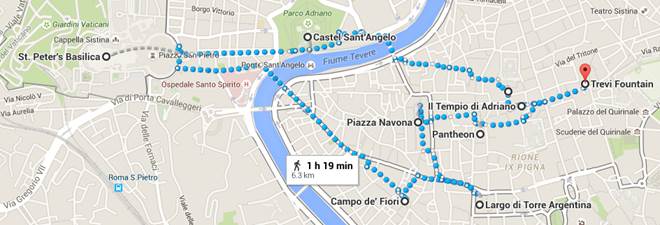
I’d say you could probably do most of the other smaller archaeological attractions and ruins in a semi-leisurely day – maybe a good day to pair with an evening Vatican tour? Start by heading West and stop at Hadrian’s Temple. Just a block away, is an Egyptian obelisk at Piazza di Monte Citorio. You could continue on to Castel Sant’Angelo and do a walk around, but you have to pay to go in. About 5 minutes West is St. Peter’s Basilica, where you probably need to plan for an hour in lineup and another 1.5 hours inside. I’d suggest that you could work your way back counter clockwise into the heart, hitting Campo di Fiori. There’s a market there where you can get something for lunch, or buy a hat for the hot Italian sun. A little East is Largo di Torre Argentina, with a wild cat colony. Next stop would be Piazza Navona, and then the Pantheon, which is a must-see. Close to your hotel and the pricey shopping district is the Spanish Steps, which we thought was a bit of a let-down (and for god's sake, don't sit on them!). We’d also not bother with Piazza del Popolo, and since we saw so many churches in Florence, we said we wouldn’t do any in Rome other than San Clemente and the Vatican, of course.

So if you managed to get an evening tour of the Vatican museum (another preview video from Mat Cain here), you’d still have another full day to explore on your own!

Have a great vacation!