Friday, August 12, 2022

The river cruise reference page

Travel and Leisure

I've created a fair bit of content over the last few years pertaining to river cruising. Each time someone on our FB river cruise group asks the same question, rather than re-type the answer again, I have usually been sending the relevant blog page that addresses the question. But today, I learned how to create "jump links" in HTML, so you can click directly to the topic, rather than reading the whole page. Some info gets duplicated across different posts, but I’ve tried to use the most thorough responses for the topics below. 

Research and Booking

Introduction to river cruising

Understanding the differences between river cruise operators

Know your budget limitations

Mass market vs. the rest of the operators

Choosing your first river cruise provider

Do you really need a "Deluxe" cruise?

Why we don't cruise with Scenic (or Tauck)

Age of guests on various river cruise operators and why it matters

Popular river cruising routes

Searching for the best river cruise prices

Balcony types on different river cruise staterooms

Layout and room categories on the ships

Choosing a stateroom for your needs and time of year

Ship decor differences - sleek and modern or classical?

River water levels - both low and high

How does time of year affect pricing?

When do the best sale prices occur?

My recent pricing comparison

Weighing out your travel priorities

Comparison and our favourite operator (so far)

Viking vs. Gate 1 river cruise observations

Pre/post-cruise excursions - on your own or through the operator?

A review of our 2022 Emerald lower Danube cruise

Another review - 2018 Gate 1 upper Danube cruise

The Tulips n' Windmills itinerary - ports and sights

The Emerald Waterways pre-cruise gifts (discontinued)

Scenic's differences (compared with Emerald)

Trip Preparation

Foreign currency: do you need it, and where to get it?

On Your Trip

Getting around in metropolitan cities

Google maps is your friend

Using the train in Europe

Mobile phone usage while you are away

Using an eSIM for your mobile phone

A typical day on a river cruise

Planning the activities for your day

Inclusions and extras to be aware of

Alcohol: what do you get and optional beverage packages

How do the inclusions differ by cruise operator?

Tipping: understanding the differences

Other European Travel Topics

Using vacation rentals like Airbnb or VRBO

Upgrading airline seats à la carte

Make sure you book your rental car early

Using Rick Steves Audio Europe Tours

Preparing vs. planning for your trip

Avoiding travel mistakes (two parts)

Do men need a day touring bag (or man purse)?

Is my iPhone camera all I need for travelling?

An 8-day Croatian travel itinerary 

Our Portugal trip with Air Canada Vacations

Some things I learned about travelling in France

Scandinavian and Baltic cruise with Princess

Opinions expressed here are solely my own and are not affiliated with any travel company or website.

Thursday, August 11, 2022

River cruising: low water levels

Travel and Leisure

"At the moment... this seems to be the worst" year in 500 years.

(Update on current conditions at the end) You don't have to look very hard to see the issues that are plaguing most of Europe right now. Heatwaves and dry weather. Massive wildfires in France, Spain and Portugal. Crop failures. Sky News is reporting that this could be the worst drought conditions seen in 500 years. This has caused major arteries like the Rhine and Danube rivers to dry up to the point where river cruise operators are forced to cancel or change itineraries. The Rhine is expected to hit critical low levels next week. Edit (17-Aug) Rhine closes to barge traffic.

Rhine River pictured in Cologne (Sky News)

I've written about this before in a previous post, but water levels can be unpredictable, and sometimes events occur that make the river(s) impassable in certain locations. While river cruise ships have a very shallow draught, some between 1.5 to 2 metres, it still may not allow them to reach some ports or traverse sections of the river. The last bad year for these drought conditions was 2018; we sailed the Danube in late May that year, and read that many subsequent cruises were diverted or cancelled that season. Unlike where I live (Vancouver), there really isn’t an annual dry season, and surprisingly, some of the wettest months in Central Europe can be June and July. Yet other dry(ish) periods of the year over there aren’t accompanied by the blistering heat of summer.

Historical Danube River water levels
What can you do about this? Nothing, really. Sure, you should have read the fine print about this when you booked your trip, but you can't predict what Mother Nature has in store for you a year out. But if you've fully paid for your cruise, all you can do is wait and see what happens. If you're lucky, maybe you will only have to say, start your cruise in a different port other than Budapest, but everything else might remain the same. Or perhaps you will end up with different ports and excursions than were originally planned for your itinerary. The level of the river can change quickly; some ships can't get through one week, and then only a week later, enough rain may arrive to change things substantially. 
Federal Institute for Hydrology (BfG) Rhine water level and forecast 08/17/22
With large operators with a huge fleet of river ships like Viking, sometimes they can do ship swaps to get around some low water issues. But with many others, your deluxe, unpack once, 7-night river cruise turns into a pack-up-every-day bus tour. And whether you've paid $2,000 or $10,000 for your trip, all the travellers get treated to the same hotels and rooms. Some operators will give you a partial refund, and some will outright cancel, giving credits or refunds depending on the line. Should you cancel? That answer is up to you, but river conditions can change quickly, and the difference between a bus tour and a full river cruise may only be a few days' worth of rain.

High water levels in Passau
But if you haven't booked anything yet, the current situation in Europe should give you pause for consideration. Is that too-good-to-be-true price for late-August 2023 really going to be worth the anxiety? Yes, this is the worst drought situation they've seen in 50-70 years, but perhaps you could/should consider a different date? In fact, historical data shows that the Danube improves in September, but the Rhine doesn’t start to recover until the start of October, so your cruise could be in jeopardy even after summer ends. But if you do wait until then, it's likely that you'll also be avoiding the crush of summer tourist season and certainly the high temperatures will be long gone. However, we cruised the Rhine in late October/early November 2009, and the river was still so low that you could "feel" the river bottom when we were in particularly shallow water. Late spring tends to be agreeable weather, and with the snow melt and glacial runoff, rivers are full; sometimes they can be too full however, and instead ships can't get under some of the bridges.

Vienna: still busy in May
I love a good deal, but the heat of the summer months is usually enough to deter me/us from sailing on Europe's waterways in July and August. Even in Vancouver, I often find the summer heat intolerable, even though the mercury only gets above 30ºC for a couple of weeks. Not to mention that every European is on vacation in August, and attractions are packed to capacity. If you fit the typical demographics of the average river cruiser, you don't have school-aged children, so there shouldn't be much forcing you to sail in the summer; most river cruise lines don't allow kids anyways. As I mentioned in my factors to consider post, prices definitely are higher in the late spring, and go up again in September, but I feel that the lower temperatures, fewer tourists, and better chance1 of agreeable river levels justify the added cost. Will you get caught by an issue with low (or high) water levels on your summertime river cruise? Odds are that you won't, but it's like booking a trip to Cancun in hurricane season... the risk is definitely higher then.

Update Aug. 24: This is how quickly things can change, and why you may not want to cancel cruises when water conditions get low. The image below is the Aug. 23rd current reading and forecast for Kaub, after a few good days of rain.
Federal Institute for Hydrology (BfG) Rhine water level and forecast 08/23/22
You can see a distinct difference between last week, and this week, as the level has risen above the critical 78 cm marker, and shows a high probability of staying above it until at least the first week of September. Ships and operators that were cancelling cruises and/or shuttling passengers around low spots, are now able to fully sail the route from Amsterdam to Budapest!

1 Opinions expressed here are my own; research conducted using historical data and weather patterns for West and Central Europe.

Like this post? Here's more river cruising ones.

Wednesday, July 27, 2022

Preparing vs. planning for travel

Travel and Leisure

Louis Pasteur once said, "Chance favours the prepared mind". Ok, what he actually said was, "In the fields of observation chance only favours the prepared mind", but I like the simplified version better. I often come back to this quote because I'm a bit of a worrywart; sometimes, when something crosses my mind, I tend to dwell on it, and if it's late at night, it even keeps me awake.

We are about two months away from our first European trip since the pandemic started. The river cruise that I've been wanting to try came up on a sale last summer, and we thought with the vaccines in full deployment, that surely things would be good by the beginning of fall 2022, right? So we pulled the trigger on the Enchantment of Eastern Europe cruise, and have planned for a week in Croatia beforehand. But then the Omicron variants appeared, and new concerns arose about how long the vaccine effectiveness would last, and whether we'd be in for a fourth, fifth and sixth wave of Covid-19. And then when we started to see the light with respect to the severity of Omicon, and countries started to lift measures, all of a sudden - BAM! Russia invades Ukraine! So I watch every newscast about war, and monitor the effect it is having on tourism in Eastern Europe's neighbouring countries; surprisingly, it hasn't been too detrimental, at least to the places we will be travelling to. 

But all of the things mentioned above are way beyond our control, so they didn't wander too far into my field of worry. However, there are things that are happening that can and should be prepared for, in order to improve the chances of an enjoyable trip. I'm not talking about booking hotels or Airbnbs in advance, so you're not left out in the cold, or planning ahead and booking your rental car at the best rate. And you probably don't need to book your rail tickets too far in advance, but prime TGV rates are usually best booked at four months out. No, I mean taking steps within your control that will remove or lessen the burden once you arrive at your destination. A simple example is all of the issues flyers are currently having with lost or delayed baggage; while it's not easy for some to pack efficiently for a two-week trip, going with carry-on luggage would ensure that you are well prepared for that potential dilemma.

So what else can we prepare for that might be an issue? Lineups at the airport can't always be avoided, and certainly you'd want to show up early to make sure you don't miss your flight. But there are programs that allow you to take the fast track through things like security screening and sometimes customs checks; e.g. Nexus, Global Entry and TSA Precheck. While these might seem like a hassle to get, they are very beneficial when you can bypass that endless security lineup that snakes out into the airport concourse. Another thing that can help you at passport checkpoints, is the e-passport, or biometric feature that almost everyone has now. The tiny chip embedded inside contains information that is used to identify the passport holder, and is readable by Near Field Technology (NFT). This is the same kind of thing that you are using when you pay with your Apple iPhone, or tap your VISA card. Instead of queueing up at the customs and immigration lineup, look for a row of kiosks or a separate one indicated by the symbol that matches the one on the front of your passport. Simply insert your passport into the reader, then a photo is taken, and you're off to get a stamp from the customs official. 

Another thing that I like to prepare for well in advance, is seat selection on our flights, especially the long haul ones. As I had written about in my avoiding travel mistakes post, I didn't do this on a long trip from Frankfurt to Harare, and ended up in the rear bulkhead, sandwiched between two large German men. Now, I make sure that I book our seats pretty much right after I've secured the reservation, and will look for the best options for us on SeatGuru. In fact, I'll even make flight or airline choices based on the type of aircraft offered, as some trans-Atlantic flights might not be in a wide-body jet. 

But what about catching your connecting flight and navigating in a foreign airport? Sometimes with a short layover time, you might want to prepare yourself for what to expect when you land at the hub airport. The in-flight magazine located in your seat pouch usually has airport terminal maps, but you can do much better by Googling the airport beforehand. In my case, someone had recorded a video on what you will experience transiting from Munich's Terminal 2 satellite to Terminal 2. And while doing my Google search for info on the Munich airport, I came across a link for an app called Passngr. It's a German portal for all things flight-related, and can give you insight into flight arrival and departure info, show you where to find food and drink, shopping and other services, as well as link you to wait times at various passport control points. As an added bonus, it enables you to use the free WiFi services at the airports, which would of course would be needed to look up the previous information.

So you've arrived at your destination... what now? How have you planned to get to your hotel or Airbnb? Because I'm so cheap, we often take the train/metro from the airport to our lodging, and walk the last 5-10 mins of the way. But many metro stations have two exits, and if you take the wrong one, you'll end up heading in the wrong direction. That's why I like to prepare in advance, and have a look at Google street view, as to what things should look like when we exit the station. You might think this is overkill, but you don't want to know the number of times that this has tripped us up, and we ended up walking 10 mins in the wrong direction!

Another thing to be prepared for once you arrive, is how to avoid the lineups at popular things to do. When we were less skilled European visitors, we didn't think to book museums or other tourist highlights ahead of time, and spent valuable day touring time standing in line. Most of the top attractions allow for online booking ahead of time, and it is usually cheaper to do so as well. Also, some will limit the total number of ticket sales, so you might not even get in, even with waiting in line. What's the risk? Well of course, you might end up changing your plans, and your pre-purchased entry tickets to Plitvice Lakes National Park go unused; but at only $50, you're not taking a huge financial leap of faith.

My final bit of advice regarding being prepared for your trip, is making sure you've downloaded the apps and data that you need for your vacation ahead of time. You never know if the Wi-Fi at the hotel or Airbnb is going to be dodgy, and things we take for granted like Google Maps navigation may not work well if you haven't downloaded an offline copy of the map data. More on using your mobile phone in Europe can be found in a more detailed post here. 

Tuesday, July 19, 2022

Top 3 river cruise questions

Travel and Leisure

I belong to a FB group for river cruising, as it's a fun way to get excited about upcoming trips, and share ideas and knowledge to others who are interested in this unique way of exploring Europe. But it would seem that many folks don't realise that you can use the search feature to find the answer to their questions, and so a number of common questions keep popping up on there. Here are the top three that seem to come up, over and over again, with my thoughts on each.

What do I wear for dinner?

Dining at the Captain's table on Uniworld
I think this one comes up so often, because of what things are like on ocean cruises (e.g. evening galas and black tie dinners). There are no such evenings on a river cruise, and for the most part, smart casual is the recommended attire. Of course when you are out and about during the day, you're going to want to be comfortable, so pretty much anything goes (within reason) for city touring as well as breakfast and lunch on the ship. However, there was one guy on our Danube cruise who wore the same tank top every day; I overheard that a staffer had polite words with him, as he stopped showing up in the dining room in that attire. I get that you want to minimise the amount of clothing that you pack in your luggage, but that guy was taking it to the extreme. But back to the question at hand. Yes, there will be a few folks who stroll in for dinner in the same outfit that they were wearing for that hike up to the ruins of Dürnstein castle, and you can't help that. I myself, tend to perspire somewhat during my day outing, so I welcome the opportunity to freshen up in our room and put on something different. On our last cruise, they discussed appropriate dinner attire at the welcome briefing, which sent a few men scurrying back to their rooms to put on some trousers and a collared shirt. But there won't be any fashion police at the entrance to the dining room, as much as most would like, turning away guests in their shorts and T-shirts; they will be getting some unwelcome side-eye from other well-dressed cruisers however.

River cruising has fine dining;
why not dress up a little for it?
Think of dinner on board as you would an evening out at an elegant restaurant back in your hometown; what would you wear in that instance? I think most would prefer that smart casual was the norm, but if the best you have is a nice, crisp pair of unfaded jeans and a collared, or polo shirt, then that will have to do. However, I personally don't recommend jeans (unless it's late fall/winter), as they get hot and uncomfortable on warm, muggy days in Europe. I like 5-pocket chinos and a collared shirt, whereas she will likely put on a skirt with her outfit; it tends to be cool in the dining room, so ladies may want a wrap/sweater. On the evenings with the welcome reception and the Captain's farewell dinner, she wears a dress, and I might throw a blazer on; this would be certainly not be mandated, and you won't be out of place without either. For heaven's sake, don't go out and buy a blazer if you don't have one, but if you're going to get one, I've discussed what kind to get here. I've discussed my clothing/packing tips in this previous post.

Do I need a travel adapter/converter?

Disclaimer: While I am/was an electrical engineer, please do your own due diligence with respect to using electrical devices in Europe. Since power technology evolved differently in other parts of the world, instead of the 120 volt/60 hertz that we use in North America, Europe uses a 230 volt/50 hertz system, and unfortunately, a few different outlet styles. Luckily for most of us, the only thing that we need power for, is to recharge the batteries in our iPads, smartphones and other portable devices. 
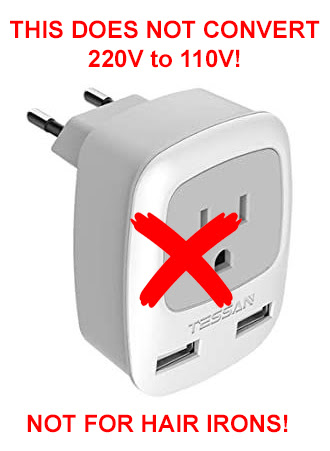
These are typically powered or charged by a USB Type-A port, with an output of 5 Vdc drawing from 5 to 18 watts. The power supply that you already own performs the conversion from AC to DC is typically rated for 110-240V, 50-60Hz, so it is going to handle the power conversion for you. The only thing that you need to be concerned about, is adapting the two flat prongs to the two round pins used in most of Europe. Now some of you may have NA-spec, 120V/60Hz sockets on your ship, but that's not going to help you when you are at hotels before or after your cruise. 
Since the Swiss socket (Type C) is like a flattened hexagon, getting adapters that will fit those will be the most versatile, as it will also fit into the round socket (Type F) in other EU countries; these are usually available 2 for $6 on Amazon. Note that you can get them for even less, as I did, but on my super cheap ones, the slots for the NA prongs are the same size, and some plugs have one prong that is slightly larger than the other; these might require a tiny bit of modification with a utility knife to make the slot slightly wider (I chose to file down the wider blade on her travel iron's plug instead).
But what if you have other electrical devices that do not have their own power conversion? That's where you will need a power converter. Note that these all-in-one converters from Amazon for $16-25 usually DO NOT convert voltage, and certainly are not be rated for high wattage devices like hair dryers and straightening/curling irons! For those, you need to look for converters that are rated for 2000 watts or more; I had one for my wife's straightener, but it was so hit and miss for some reason, and so she ended up getting a dual voltage one instead, avoiding the problems with trying to convert the power altogether. Update: I wrote a little bit more detailed piece on adapters here.

Do I need/where should I get euros/foreign currency

We needed cash at the Lorenzo Street Market
While the almighty US dollar is the benchmark against which all other currencies are measured, places that don’t take credit card DO NOT want your American dollars. Imagine that you are running a hot dog stand in the US, and some tourist offers you euros? Anyhow, it used to be that you pretty much needed to have some running-around money, as some small restaurants, shops and street markets would only take cash. But with the pandemic, contactless payment options became the norm, and almost anywhere you go, you will be able to use your credit card (take note of your provider's foreign transaction fees; we use the Home Trust Visa for Europe). Regardless, I like to have some local currency on me, as there are a few things that you do need cash for. One is the public toilets; unless you use your cash to buy something small, you won't have any coins to use the facilities. And don't forget that not everyone uses the euro; even though they may be part of the EU Schengen zone, they might still have their own currency. e.g. Hungary uses the forint, the Czech Republic has the koruna, etc. Sure, some folks might accept euros, or even US dollars, but they will not give you a very good exchange rate.

While there are those that would swear that they are getting the best exchange rate at the Forex kiosks in the airport, I'd tend to disagree, as I can usually get the best value at my home bank, and typically can even do a little bit of bargaining with the teller. Of course, you can/should be able to get cash from the ATMs that are everywhere in Europe, but make sure you are going to a trusted financial institution, and not some dodgy location inside a pub or at the entrance to the casino; these will give you a terrible exchange rate as well as slap you with a high transaction fee! And when the machine asks you if you want them to do the exchange for you, always decline that, as your home bank will give you a better conversion; the same goes for using your credit card in a retail store or restaurant. How much cash you need is subjective; we don't do a lot of shopping, so would probably only bring the equivalent of $300 USD for a 2-week trip, and then top up at an ATM if we needed more. We did run into one situation in Portugal however, where every cash machine we went to would not give us euros!

Enjoying reading posts about river cruising? Click here for more!

Wednesday, June 22, 2022

Factors to consider when choosing a river cruise

Travel and Leisure

This question comes up regularly in the Facebook group I belong to, "We're new to river cruising... which is the best company to go with?" This question to me is like, "I've never driven a car, but I was wondering if someone could recommend one for me." Everyone will have different needs and wants, so it seems a little odd that one would ask complete strangers for advice for their next European vacation. There are so many variables that go into choosing your European vacation provider, so I thought I'd jot down some thoughts for your consideration.

Budget

This is likely the number one factor for most of you reading this; in fact, the rest of your consideration factors essentially need to be balanced out against the different financial options. I'll explain more on that below, but if budget is not a concern, you can probably stop reading this blog post, and go with Tauck. I mean, if you have a Bentley sitting in the garage, there probably wasn't even a consideration of who to sail Europe's waterways with. Have I been on Tauck? No, but I don't need own a Bentley to know that you're going to have an exceptional drive. But for the rest of us who drive Fords and Hyundais, who find that a Tauck cruise at $850-1,000/night1 can't be justified, what are the next best options? I've done a price comparison before, and the other two Deluxe operators' (Uniworld and Scenic) list prices come in at around $800/night. You should be able to find decent sale prices for those two (edit: Scenic has been offering 2-for-1 deals through Travelzoo promos), but if you move downmarket into the First Class category, you'll find prices on Ama, Avalon, Emerald and Viking in the $550-750/night range, but usually good promos can bring those down to $300-450/night. Signing up for discount emails from the various operators and marketing sites can bring things down to a very palatable $200-250/night. Be on the lookout for 2-for-1 sales and promotions; of course, someone always says, "you get what you pay for", but in our experience, you get the same cruise that others are getting, just for much less money.

Quantity vs. Quality

When people ask the question on the group, "who's your favourite river cruise operator?", the highest number of results will come back with Viking. Why Viking? It's because they have the most ships and have the largest marketing budget. If say, 70 out of 100 cruisers have sailed with Viking, when you ask the question, you're probably going to get 70% saying that Viking was their choice. It's like saying, who knows who McDonalds is? Everyone does, of course, but do they make the best hamburgers, or is that the restaurant for you? That's subjective, but most would say that their product is very predictable and consistent. I'd argue that Viking is the same; while there are some that complain about their pre-payment policy, they can't have the most ships without delivering a decent quality service, over and over again. Many folks have commented however, that Viking does put the most guests per ship, compared to other brands. Less well-known names with a fraction of the number of ships seem to spend less on marketing and may offer a better experience, with fewer travellers packed onto your ship. Edit: With the recent Rhine water level issues, it is worth noting that Viking having so many ships can be beneficial when the water is too low or too high; they are able to offer "ship swap" modifications to the itinerary, whereas other operators may skip ports, or cancel cruises entirely.

Balancing your travel priorities

So what may be right for the majority of river cruisers, may not be right for you. Unfortunately, that's where the difficulty comes in for most newbies to this unique form of European travel; they don't know what river cruising is like, and therefore don't know how to differentiate the multitude of offers. But what are your priorities with respect to travel? Duration? Time of year? Flexibility? Exclusivity? Inclusions? Activities? Are you more interested in the "itinerary" and are just using the cruise as a floating mini-hotel with boutique restaurant, or is the cruise experience why you are going, and don't really care where you are? I guess my suggestion in this area, is that unless you have buckets of cash, trade-offs can and need to be made in order to satisfy the higher priority factors. e.g. If budget is more important than say, time of year, you are probably going to have to sacrifice something, and sail in the heat of the summer, when Europe is at its busiest, and river cruising prices are the lowest. Or maybe you just can't possibly think of travelling without a butler, so you're going to be limited to sailing with Scenic, or Uniworld (in a suite). And sure we'd like to have bicycles available for use, but is not having them worth passing up a $200/night sale on Gate 1 who doesn't offer them? I can't tell you what your priorities are, but as you peruse the different options available, make note of what your most important factors are, and be prepared to sacrifice the ones lower down your list.

Which operator?

Since I'm writing this primarily for river cruising newbies, who may never have set foot in Europe, this is an important factor that relates to the first one, budget. I wrote an entire post on this, but since you've never done a river cruise, virtually any First Class operator and route will delight you. It's like a high-definition TV; if you've never watched a movie on a 4k screen, you don't know what you're missing with your normal 1080p one. Sure, there are regional differences to each route, but the overall experience is pretty much the same. Yes, the Deluxe operators will have some perks and offerings that you can't/won't get on a 1st Class cruise, but you won't be regretting not having these, since you don't have any frame of reference. And I've stood on shore, waiting for our walking tour to depart, watching the tour guides who have just finished with one group, take off their Viking lanyards and QuietVox headsets, exchanging them for the Gate 1 versions; i.e. the walking tour you get with one operator is the same as the other operators' guests will experience. My message to the newbies here, is don't get caught up in the marketing fluff; you're going to have a great time regardless, so pick the one that best suits your budget and matches with your priorities.

When to go

This is probably going to come as a surprise, but peak season(s) for river cruising are late spring/early summer and late summer. Prices start to increase as the temperatures warm up in spring, but ease up in the heat of the summer, and climb back up later into September. I believe this also coincides with the demographics of the average river cruiser; early 60s to late 70s retirees with no kids to worry about. If you match that description, you're probably also going to want to avoid the heat and crowds in Europe in the summer. Therefore, some of the best sale prices you'll find will be in mid-August, but do you really want to brave the heat and battle with all of the tourists then? Of course there are other cruises where you don't have a choice of timing - e.g. Tulips and Windmills and Christmas Markets. But for most of the rest, you might want to sacrifice some budget to go at a more suitable time of year. There is also the issue of water levels in the river being too high in the spring, or too low in the late summer, but you can't really plan around that. This is especially true this summer; read more on water levels in this post.

Room choice

This is a topic that gets a lot of excited debate in the FB group. Some will swear that you absolutely need to be in a Viking Veranda Suite to enjoy your trip. Others will prefer to save money and opt for the small rooms at the bottom of the ship, with only small, water-level windows to peer out of (I don't recommend these rooms). This is where your priorities come in, and should influence your choice of provider and room. Christmas market cruising? You probably don't want to shell out big bucks for a dedicated outdoor space in the wintertime. Bed absolutely has to face the windows? Avalon. I wrote a more extensive piece on the different types of "balconies" available, but what I want to bring up is the delta in price to move up from the base package. On a 7-night cruise for example, to upgrade from the cheapest room on Viking to a tiny French balcony room will add another $500-600 per person. A larger Veranda room will add $1,000-1,200. On Gate 1's flagship, the Monarch Empress, moving up to a French balcony room for 7-nights varies between $200-400, and an Emerald upgrade to a 180 sq. ft. Panorama stateroom will only set you back $360 per person. 

Ship decor

I wasn't going to write about this, but there is one operator that has interior decor that cruisers either love or hate - Uniworld. Where most operators have gone with clean, sleek lines (e.g. Emerald, Scenic) and others have stayed with contemporary looks (Avalon, Tauck), Uniworld's interiors that some consider too gaudy. It wouldn't be a big issue if you were getting a great deal, and you could overlook the opulent style for a week or so, but their rates are among the highest. Some of their rooms on the middle deck also don't have windows that open (their "regal" series of ships), so you'd have to put up with the outlandish decor AND not be able to have any fresh air in your room. Don't believe me? Have a look at this article from Business Insider.

Independent travel vs. fully guided

Lanyard-free exploring
This is the primary difference between a Deluxe, fully all-inclusive river cruise, and the rest of the 1st Class operators. Are you an independent traveller? Or do you prefer to be pampered virtually every moment of your day? If you're looking at river cruises, you are probably somewhere in-between, but my research would indicate that the more independent you are, the less you need to spend on your river cruise. e.g. With a 1st class cruise, once you have finished the free, included walking tour of the old town area, you can just put your tour lanyard in your pocket, and head off on your own. Go back to the ship for a gourmet lunch? Nah, just grab some schnitzel in town, and keep doing your own thing. Meanwhile, the folks that have paid a premium for a deluxe, fully organized trip, will probably be carted back to the ship for lunch, and be taken off to the next scheduled tour, whether they wanted it or not. Not a fan of the symphony? No problem, since you haven't paid for the optional Schönbrunn Palace concert. In our experience, some of the optional tours take too much time away from your own self-guided options, and use up that precious time that you have in port.

Activity level / average age of guests

Not wheelchair-friendly
It may not surprise you that there are not many/no young people who participate on river cruises, probably due to the relatively high cost, and perceptions of what it is like travelling on European waterways. Some operators do offer more active excursions (Avalon, Emerald, Ama) and many have bikes available for self-guided cycling in or between ports. On the flip side, virtually all lines will have a “slow walkers” group for the daily excursions, but sometimes this does not equate to less walking, just a slow(er) pace. I’ve read that Viking has an older demographic that others, and when we sailed on Uniworld and Vantage, we estimated the average age to be late 70s. Boarding the small canal boat in Bruges (pictured) was an extremely difficult task for some members in our group, and pretty much everything moved slower than we would have liked. While you can’t choose who the other guests on your ship will be, it is a factor to consider when selecting your river cruise operator. I have a hypothesis that the more expensive a cruise costs, the older the average age will be. Our upper Danube cruise was with Gate 1, the leader in river cruise price/performance, we were pleasantly surprised that the average age was in the 60s. This made things like going through evening port talks, and loading/unloading coaches go much more smoothly and efficiently. We also noticed a much higher participation in the evening entertainment events; on our other two cruises, the lounge was virtually empty after dinner.

Beverage services

Another common question comes up on the group with respect to alcohol, and what is included vs. the fully all-inclusive operators. I think one important point should be noted, is that unlike an ocean cruise, you don't really spend that much time on the ship. Think of it as a luxury, floating boutique hotel; with all of the daily tours and activities (self-planned or organised by the operator) that you end up doing, we find that we barely have time for one drink before heading to the dining room. Everyone includes beer and wine with lunch and dinner, and you typically only pay for drinks and cocktails in the lounge. There's even a couple of evenings where they offer free cocktails in the lounge (welcome reception and Captain's farewell dinner), and some lines have free bevvies during happy hour. So unless you take your drinking seriously, I'd suggest that the alcohol package (if offered) may not be worth it; you can always buy a drink here or there, à la carte.

Other inclusions / options

The Deluxe operators will sell you on an exclusive, fully all-inclusive river cruise, with nothing left for you to buy, and many will swear by the ability to "leave your wallet at home!" For a first-timer, this has a lot of appeal, especially if they have experience with ocean cruising, where almost everything comes with an additional cost. However, for pretty much all the operators that fall into the 1st Class category, it is what I like to call "almost all-inclusive". Aside from alcohol noted above, there are very few extra things that you might have to pay for over and above the initial package price. Usually, there will be optional tours (over and above the included daily excursion), and these range in price from $60-100 per person. Tips can sometimes be pre-paid, and are ~$20/night pp for onboard staff, and €2 per guide for onshore tours. So for a typical 1st Class, 7-night river cruise, you might end up paying $300 per person for these extras; Tauck, Scenic and Uniworld cruisers will say that they don't have to worry about these, but they are essentially pre-paying for all of these and more. Everyone lists their inclusions on their webpage, and any optional tours that you might find interesting; it's very easy to total up what you might end up paying with a 1st Class cruise and determine if the additional $2,500-3,000 per person is worth going up to a Deluxe operator. 

When to buy?

This is a good question that comes up on the FB group only occasionally, "when are the best deals available?" For most operators, their sailing season starts in early spring, and continues right through to Christmas Markets in December. But that doesn't mean you need to time your search around the approximate departure date of your potential cruise. Operators offer sales all year round, typically coinciding with traditional sale events (e.g. Canada Day, Black Friday, etc.). Sometimes, this means buying (or at least placing your deposit) over a year in advance. Yes, last minute deals do come up, but I'd call them more like "last few months deals", as I've seen deeply discounted fares on unsold rooms from 3 to 6 months out. If you're flexible on route and dates, you will have the best shot at securing a ridiculous deal on a First Class river cruise. And I'm not talking about a $300/night rate on a mid-August sailing; no, you can find great options for May/June and September/early October if you are patient. Update: I have noticed that recently the middle deck, rear staterooms (usually exactly the same as the rest of the French balcony rooms) are selling out quickly - e.g. even a year in advance. So my typical advice of waiting for the best deal to come around may not work if you're really wanting that late-September Rhine cruise.

I'm sure that some of you may have other deciding factors that will play into your next river cruise buying decision, but I hope that these ideas will give you fuel for thought.

Want to read more river cruising posts? Click here.

1 all prices discussed in this post are USD or approximated USD equivalent; all rooms compared are French balcony or equivalent

Friday, May 13, 2022

What is up with Emerald Cruises?

Travel and Leisure

I belong to a Facebook group that is dedicated to river cruising; it's a fun way to learn about this unique way of travel, and share thoughts and experiences. Recently, there's been a few folks who have indicated that their Emerald cruise had been cancelled, with very short notice (often less than three weeks prior to embarkation). Similarly, there have been a few posts about Scenic cancellations, which is the parent company for Emerald.

So what is happening here? Some think that Emerald is simply cancelling and consolidating undersold cruises; if they are really doing this, they are supposed to be letting booked passengers know they've been cancelled 60 days notice prior to departure. There was also a perfect storm brewing earlier this year when Emerald/Scenic was hacked, causing an IT outage that took out their systems right around the time when travellers were getting ready to book post-pandemic trips, and indeed, filling potential empty rooms. But I think that there's a couple of other factors playing here too. My hypothesis is that when the pandemic hit, cruise staff had to go find other jobs; now that cruising has resumed, they all haven't returned to their pre-pandemic roles, and Emerald/Scenic struggled to fill vacant positions. Additionally, while Covid-19 doesn't pose a life-threatening risk for most of us since we are fully vaccinated, there can still be outbreaks that will take crew members out of service for 5 days or more. These factors seem to have been playing out, as I received this response from another group member, who received the following from Scenic w.r.t. their cruise cancellations:

"The whole team are excited to welcome back our river cruising guests in Europe, with over 40 cruises departing across our Scenic Group fleet (including our Scenic Space-Ships and Emerald Cruises Star-Ships), delivering guests a truly unsurpassed cruising experience on the magnificent waterways of Europe. 

Scenic Group, was required to reschedule a small number of our early season river cruises, due to an unexpected and short-term shortage of crew members, which caused a delay in the release of visa applications.

We apologise to our impacted guests, and have worked to seamlessly adjust guest’s arrangements to alternative river cruises as a priority to ensure minimal impact. Our commitment to delivering an enriching luxury river cruising experience for our guests was at the forefront of our decision making, and our crew are an integral part of this.

We continue to closely monitor these global challenges and continue to be focused on what we love to do, bringing the wonder, luxury and joy to our guest’s cruising experience, as they journey with us in Europe."

But with an Emerald cruise booked for this October, I wanted to try and determine if there was a high likelihood that ours could be cancelled as well. Is it 50%? Or something more like 10%? So with selfish intent, I asked the group who had been cancelled by Emerald, and what route and date they were embarking on the ship. Now I know that this is a totally unscientific evaluation; who knows how many guests are on these cruises that are not members of the FB group? And what percentage of the cancelled group members are actually going to go to the group page, see my post, and comment on it? While the methodology is likely flawed, I had committed to providing an update to the FB group, so let's continue.

(Updated) As of May 16, only five (5) travellers have come forward to indicate that their Emerald cruise was cancelled this season; I don't expect any more. I counted the number of cruises for April and May, and it amounted to around 69 sailings. So that's about a 7% cancellation rate - a far cry from my feared 50%. Statistically however, what has happened does not have a bearing on future cruises, as Emerald (and Scenic) may have resolved their staffing issues now. But if we look at which routes cancelled, that may be more valuable. Three were Danube trips; I thought that since the lower portion of the Danube isn't the most popular, that two of these might have been undersold, but one of the cancelled guests indicated that her sailing was nearly full! This leads me to believe that the Danube ships were/are having staffing problems rather than undersold rooms. The other two were Rhine and the 2-week Amsterdam to Budapest sailings, both in April; since no other cancellations were reported in that region after April, perhaps they sorted out the staff challenges sooner? In the end, we will never know what caused these cancellations, and the data cannot be extrapolated to other routes; e.g. despite the fact that no sailings were reported cancelled on the Douro, that doesn't mean it didn't, and can't happen.
Our Emerald Destiny ship is 80% booked for October!

So have I alleviated any concerns about my cruise being cancelled? No. Without any concrete facts and with the limited data gathered, this endeavour was a bit of a bust. However, with the Emerald booking site back up and running, I was able to mock up a booking on our sailing date, and can see that there are only 11 Panorama Balcony Suites (Cat C, B, and A) left to choose from! With a capacity of 60 available, they're at over 80% occupied in the decent rooms, making it unlikely that they'd cancel our sailing due to being undersold. I know that ships often sail with a lot more empty staterooms than this, so I am starting to feel pretty good about our early fall trip, Covid pandemic and water levels notwithstanding.

But in the end, if you want some peace of mind, it still makes sense to plan for the unexpected, and develop a contingency plan that you can "pivot" to, if necessary.

Sunday, May 1, 2022

A new unit of value (for me)

Retirement Life

This one is going to take a bit to explain. There’s a 2002 movie called, “About A Boy” starring Hugh Grant. It’s a cute, feel-good movie about an immature young man named Will (Grant) who learns how to act like a grown-up through his interaction with a little boy. Anyhow, as part of his character development, we learn from Will how he divides his day into blocks of time or “units”, which equal half-hour periods. 

For example, watching a TV show, well that’s one unit. Internet research (flash cut to Will typing into the url field supermodelswithseethroughtops.com): two units. A visit to the local pub: three units. You get the idea. For years, I've been using this in various forms, so I decided to put this concept into play as a way of measuring my purchases through the work I perform.

As you might have gleaned from past posts, I pass some of my spare time by being an Extra in local TV and film production here in Vancouver. We aren’t referred to as Extras really, I think because that implies something trivial, or added as an afterthought, when we really can be integral to the scene, and sometimes play a pivotal role for the actors to put themselves into character. Referred to in the industry as Background (or BG for short), we are placed on set to add realism and a moving environment for the camera. 

Covid-era Background Holding
Most days on set involve a lot of downtime; sitting around in “Background Holding”, where you can read a book, watch some Netflix, chat with friends, or even have a brief nap. Sure, when the Background Wrangler calls you to set, you need to drop everything, and go do your thing, but you’re effectively being paid for doing nothing most of the time. My wife was chatting with our neighbour over the fence one day, and she was telling her how I had been working in Background. She told her, “It’s great for him; he gets fed, meets up with his friends, can read a book, and it fills his day.” Our neighbour exclaimed, “You put him in daycare!” Which is not far from the truth, in reality.

Anyhow, since this retirement hobby isn’t a revenue-generation necessity, I consider the income I receive from Background work as sort of a bonus. And sometimes, it can be substantial; while a minimum day is only $225, a longer day brings in overtime pay, and sometimes double-time, and can total $450 or more! And not long ago on a brief 4-hour shoot, I was “upgraded to actor” (more on that in another post), which tallied up to over $1,100!

But the basic day, after commissions paid to my agent, is about $200, or what I refer to as one “Background Unit”. So for the last few years, when I consider buying something, especially a purchase that might seem extravagant or perhaps a little out of range for my Scottish financial upbringing, it becomes defined by the number of Background Units it would cost. A new pair of Gore-Tex shoes? One Background Unit. Seat selections for our upcoming overseas flights? Two Background Units. New patio dining chairs? Well that was five Background Units. 

Anyhow, I don't think it will be recognised by the IMF, but for the time being, it's my new way of measuring value.

"About a Boy" images courtesy of Universal Pictures.