Saturday, October 28, 2023

To Airbnb, or not to Airbnb?

Travel and Leisure

Vacation rentals might be the only way to stay inside the Old Town areas
Having recently returned from 19 nights in France where we stayed exclusively in vacation rentals, I thought this would be a good topic for my morning coffee. There are many pros and cons to staying in an Airbnb versus a traditional hotel, and so I'll try to outline the differences here. Are you an infrequent traveller? Then you can probably stop reading this now; vacation rentals are probably not for you. It's not that you won't have a good experience - I just think that Airbnb and VRBO are for people who are more adept at travel, and know what to look for and what they can expect.

Introduction to vacation rentals

Bonus: small living room
We were introduced to vacation rentals not by choice, as I had a business conference to attend, but all the hotels were sold out. It was 2006, and the 3GSM World Congress that took place in Barcelona brought in exhibitors and attendees from all over the world. By the time I had received my corporate travel approval, all of the hotels were sold out. It was my wife (then a travel agent) who suggested to look at a vacation rental site (now gone/absorbed by Expedia.com, I think). I booked a simple, one-bedroom suite for much less than what a hotel room would have cost, if they had been available. But it was very modest accommodations; comfortable, but sparsely furnished and equipped almost exclusively by Ikea.
View from Barcelona balcony
But unlike a typical European 3-star hotel room, this had a nice sitting area, separate bedroom and a small kitchen and dining area. It was more than we needed, as she (tagging along on the trip) was out during the day exploring, while I attended the conference. The location however, was awesome - just a block or so off the busy Las Ramblas area, it was the perfect spot for Barcelona newbies. As we'd later find out, most business hotels are not in the neat old town area that most tourists want to see, so it ended up being a great stay for us, despite the spartan nature of the apartment.

What to expect in a vacation rental

There's no reason to describe a typical European hotel experience, as that is pretty standard for most hotels you'll encounter in Western Europe - except that the average 3 to 4-star hotel is going to be a smaller room compared to North American, chain-style ones. But just like hotels, Airbnbs and VRBO rentals will have photos, star ratings and reviews, so you can easily select the level of accommodations you would we comfortable in.
Living room in Reims Airbnb
You should be able to get a good perspective of what the place will be like from the pictures listed on the owner's listing; we'd try to avoid ones that have few, or poor quality images. What you can't get from the images is the quality of the property - anything looks good in pictures, but what does the bed feel like? Or is the bathroom height too low for tall folks? These are things that get mentioned in past guest reviews. Similarly, some units will be sparsely equipped, with exactly four plates, bowls, etc., and only the bare minimum number of towels. Conversely, others might have ample supplies and amenities that you weren't expecting, like travel adapters/USB chargers, tea/coffee supplies, or beach items, if situated nearby. Obviously, you can check the listings prior to booking for things you want/need, like a fridge, coffee maker, A/C, or laundry machines.

What you don't get

Google street view is handy
As a past, frequent traveller for business, I've gotten quite used to the typical hotel stay, and the arrival and check-in process is usually quite simple. Hop in a taxi and say, "Hilton downtown please" - and off you go; you roll up to the front desk, present your ID and credit card, and minutes later, you're in a comfy room. Conversely, getting to, and checking in is one of the conveniences that you'll forego with a vacation rental. You need to know the explicit information on your apartment's location, and entry information; sometimes, Google Maps doesn't picture the right address, as we found in Reims. Often, you'll be doing self-check-in, using either a lockbox or a secure keypad entry. Rare are the days where you meet your host at the door, but that is consideration to be aware of, as you may need mobile phone service to coordinate that. 
Lockboxes take getting used to
Even if you are well equipped with all the information you think you need, it can still be a little bit of a challenge; "which way to our suite?", or "do I press the code first, then enter, or star, code, then enter?". Once inside, you'll probably go, "ah, this is what I saw on the website", and wander around to check out the facilities. Of course, there's no bellhop (and usually no owner) to show you the features of your accommodations, so it takes a few minutes to figure that out sometimes.
"But where are the towels?"
At our spacious place in Dijon, we had to search for the towels, which we found were stored in the bedroom (vs. bathroom), and plates/cutlery were housed in the dining room (vs. kitchen). Don't expect a lot of bathroom toiletries (we bring our own shampoo/conditioner), and Europeans apparently don't use bar soap (again, bring yours along, or buy there). Wash cloths or face cloths are also not commonly supplied (even in 3-star hotels in Europe), so she brings one of those too. You won't get daily housekeeping services at your vacation rental; we don't typically need this, but things that the staff would re-supply in a hotel won't be available to you. e.g. we had to let the owner in Colmar know that he hadn't given us enough TP for the duration of our stay (a communication error), so he popped by with some one day. 
Some provide ample coffee pods
Most will provide enough coffee or tea for one morning, but since there is no daily service, you'll need to get more coffee pods or what-have-you from the supermarket. To us, this is one of the benefits really, as we like to have a basic breakfast of fruit, toast and yoghurt in the apartment, versus paying 15€ for a hot buffet at a hotel.
In-room amenities that you might miss will probably be English-language TV channels (if there's a TV present). Unlike hotels that cater to North Americans' appetite for small screen entertainment, most European vacation rentals won't have any channels that will be of any value. Some better units will provide an Apple TV or similar device that you can stream your iPad to, but for the most part, if don't count on any TV services, you won't be disappointed.
Elevator to the top floor?
Another thing to consider is accessibility; this isn't an issue for us yet, but something that you should look out for if necessary. Your Airbnb might be in a centuries-old building, on the top floor, up a steep set of stairs; even lugging your suitcase up without an elevator might be cause for not booking these. Or in our case, one bathroom was so tight that, um, people of a larger persuasion might not fit in - literally.
The other big thing that most might miss in a vacation rental is concierge services; i.e. a simple place to get your questions answered. Where is a decent place to eat closeby? Where is the nearest Metro stop? Can you arrange a taxi/trip to the nearby {xyz} attraction? That's the convenience of a normal hotel, but if you're a savvy traveller, you probably haven't needed a concierge in years. Also, most/many hosts will provide a number of destination recommendations for you. e.g. in Dijon, our host gave us the names of a few good value restaurants; we ate our best meal in town for 42€!

So why an Airbnb or VRBO?

Kitchen facilities allow for easy breakfasts
Again, I'll reiterate that we're relatively savvy travellers, and know what we don't need, and what we want from accommodations while we're overseas. We would prefer to make something light for breakfast in the small kitchen, rather than having to get dressed etc. to go downstairs for to the hotel's restaurant. But what we do like, is to be really close to the heart of the city, so we can pop out easily for dinner, and have the local attractions and sights nearby. This isn't always going to be the case for hotels, as in many of these cramped old town areas, there is no space for a big, new US-style hotel. e.g. inside the city walls of Dubrovnik, you pretty much have to go with a vacation rental or a small, pensione-style lodging.
Massive bedroom in our Dijon Airbnb
Another consideration that we find is a benefit, is the amount of space you get in a vacation rental. Of course, you can book small, studio-size places if supply or price is prohibitive, but we find that for our budget range, you can easily get spacious (~850 sq. ft. or larger), one-bedroom accommodations. When you compare to a typical European hotel room that is basically a small bedroom with an ensuite bathroom, there's no contest. Agreed - we don't spend a ton of time in there, but it is nice to have space for the two of us to move around and relax when we are back from our day's exploring.
Paris Expedia hotel prices!
I mentioned it earlier, but pricing is also a factor that we like. For the most part, you can find reasonable, 3-star hotels in most of Europe for sub-$200 a night, sometimes much less. But factors like time of year, and other events can drive up the cost quickly, as we found with our September 2023 trip to France. With only the World Cup Rugby to explain it, we found that hotels in Paris were charging around 5x their normal prices! Most vacation rentals do have a season rate adjustment, but certainly it will not match with that kind of demand-based increases. A 3-star hotel around the Bastille in Paris that we had booked for September 2020 was CDN$175 per night; for the same timeframe in 2023, the price had jumped to $800! Luckily, we found a studio VRBO on the West edge of the Marais district for $180/night; after many days of logging 20,000 steps or more, we were thrilled to be in such close proximity to restaurants and shops.
Washer AND separate dryer!
Since we typically only travel with carry on luggage, we choose vacation rentals that have laundry amenities. Many don't have any machines, so it's something you have to put in your search filter; some will also have a separate dryer (desirable), and some will have a washer only. The European combo washer/dryer units that we've encountered will do an adequate job of laundering your stuff, but it takes a loooong time. It's one of the reasons why we pack clothing that is relatively quick drying; even if using the drying rack or the glacially slow combo dryer, it will still be dry in the morning.

Ultimately, choosing whether to use an Airbnb or not is up to each individual's needs and desires, but we prefer it. Sure, we've had a couple of stays that didn't live exactly up to expectations, but for the most part, if you do your research, you shouldn't be disappointed.

Monday, October 16, 2023

Tour de France 2023

Travel and Leisure

Best viewed on iPad or browser

I went looking for some details on our French trip, and couldn't find it, so I thought I'd do an abbreviated photo-documentary of our 21-day tour de France. Follow our clockwise route from Paris below; clicking on the images will open a gallery view with higher resolution photos. And there's detail on what it's like travelling in France in this blog post: Things I learned in France.

Our tour began by immediately heading to Reims on the TGV upon arrival at CDG. Pronounced “rance”, Reims is located in the heart of the Champagne region. Many tourists do Reims as a day-trip from Paris, and that is certainly doable, but we were heading east, so it made sense to stay here, and we also tried to use it as a decompression stop from our trans-Atlantic flight.
Rather than TGV it right to the Alsace region, it looked like Nancy was worth a look, so we booked a night there. With a metropolitan population of a little over twice that of Reims, Nancy felt bigger, and for those looking to visit, it merits a stay here.
We moved on to our new Airbnb base in Alsace for 5 nights, the incredibly cute town of Colmar. We'd been here briefly back in 2009 on our first river cruise, so we knew that it was worth coming back to explore in more depth. 
Some that visit this region prefer to stay in Strasbourg (below), but Colmar is actually closer to most of the sights and attractions that we wanted to visit, and has a similar (but much smaller) feel than Strasbourg.
With only four full days in Colmar, day trips in the region included Château du Haut-Kœnigsbourg (below), the Alsace wine route, and going back to Strasbourg. The Château fell into ruins, but after German Emperor Wilhelm II took ownership, he had architect Bobo Ebhardt painstakingly reconstruct it in the early 1900s.
We did all this using the efficient train system, except for the wine route, where the Kut'zig hop on hop off shuttle was a bit of a failure (detailed in the post earlier). The postcard-cute towns of the Alsace are worthy of a day's touring, that's for sure. We’d been to Riquewhir on our river cruise, but Kaysersberg, and Eguisheim are the other ones that stand out.
Our next Airbnb for the next 5 days was in Dijon, in the Burgundy region. Again, with train travel bookending our stay, we only had 4 full days in the region. It’s a big city, but it has a charming old town centre and amazing architecture. 
Day trips included Beaune, Besançon, and Lyon. Surprisingly, Beaune (below) was a bit of a disappointment for us; it had been over-hyped in everything we read, and just didn’t seem to have the charm that we’d come to expect from the Alsace towns.
The citadel at Besançon was huge (couldn't really capture a photo of it), and is the highlight there, but there was a lot to see along the main drag that winds through town. Roman-era structures and gates still loom over roadways.
Lyon was better than I had been expecting, especially the Roman ruins at Lugdunum and the museum there, along with the Vieux Lyon area.
After our time in the Burgundy region, it was time to head back to Paris for the last leg of our trip. We chose a VRBO in the heart of the city, just west of the Pompidou Centre. We had originally booked a hotel for the trip we had planned in 2020, but Covid forced us to cancel. For the dates we wanted to rebook in 2023, it ended up that the Rugby World Cup was taking place during the same time and hotels were charging outrageous prices. It ended up being great, as the neighbourhood was very central (i.e. walking distance) to many sights, shops and restaurants.
There's so much to see in Paris, so we used a combination of Rick Steves walking tours on his Audio Europe app, and ones that I recorded from his book. It made wandering around Paris a little more structured, and added great colour-commentary to the sights in the city. The first Sunday of each month is free museum day, but rather that join the mobs of people at the Louvre and Orsay, we chose the smaller ones to visit instead.
We ventured into the Montmartre district (the one area that we really needed to use the Metro for), and unfortunately it was also the one day that it rained on us, but only for the morning. We wandered down to the Place de la Concorde, then walked up Les Champs Élysées to the Arc de Triomphe.
We bought the Paris Museum pass for 48 hours, and started it at the end of the day above, to go up to the Arc for views of Paris, and then blitzed the rest of the major museums and included attractions the next day. Again, using Rick’s audio tours, we got the highlights of the Louvre, L’Orangerie, Orsay and a couple of other sites included in the PMP. 
Last day-trip for our Tour de France was Versailles (also included in the PMP, and since we were still within the 48 hour period, we were able to use that to get in). It is a sprawling, amazing complex, which was a perfect ending to our vacation.

Sunday, August 6, 2023

Tulips n' Windmills river cruise

Travel and Leisure

I had previously written about our two most recent river cruises (upper Danube with Gate 1 and lower Danube with Emerald), but someone posted a request for this itinerary on the Facebook group the other day, so I thought I'd jot down some thoughts and notes regarding our experience. Since we travelled with Vantage, which is now bankrupt, this post will be more about the stops and places visited rather than a review of Vantage, for obvious reasons. 

The route for this region will vary by river cruise operator, so this is something that you should make sure you understand before booking. We chose this itinerary (and Vantage) on a whim, as we came across a ludicrous deal on Travelzoo that we couldn't refuse (well under $200 per night in a French balcony room). Of course, the timing for this cruise is springtime, so you typically only have a month's worth of sailings for a given operator to choose from; mid-April to the end of the month seems to be the sweet spot for the best chance of catching the tulips in full bloom.

Pre-cruise extension in Brussels

We never fly in and head directly to the ship; getting over the trans-Atlantic flight and ensuring that any travel delays don't affect our cruise are important factors for us. Since we were embarking in Antwerp, we booked two nights in Brussels. There are folks that will say that Brussels isn't worth visiting, but we'd disagree, and the old town area and the Grand Place are certainly worthy of a visit.
We stayed at the Ibis/Novotel Brussels off Grand Place, which as it sounds, is right off the Grand Place, and only a short few minutes walk from the Brussel-Centraal station. If you haven't stayed at an Ibis or Novotel chain, they are modest, but clean and comfortable hotels that you can find all over Europe. We had our eye on a cute B&B on the other side of the old town area, but they were only available for one night, so settled with the Ibis. We didn't opt for their breakfast package (15€ per person), but we found a little café in the beautiful Galeries Royales across the street.
For only 7€ each, we got this massive amount of carbs to start our day. We actually ate only the croissants, juice and coffee, and took the baguette and cheese along for our mid-morning snack. It's not something I/we normally do, but neither is a 5-km walk before lunchtime. So a tip for you first-time European travellers, is to stock up a bit more on your food intake for breakfast or bring a snack, as you might need a little more energy than you are used to. 

Embarkation and Day 1 in Antwerp

Since we did our own pre-cruise extension, even if the cruise operator had included transfers for us, they wouldn’t have been applicable. It was a short and easy train ride from Brussels to Antwerp, then a brief taxi trip to the port where our ship was waiting. Interestingly, since the port there is tidal, when we arrived, we couldn’t even see the ship, and the only thing visible at the dock was a banner for the cruise line. We walked down a ramp onto the top deck and then down the stairs to the front desk for an efficient check-in.
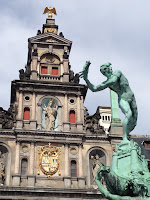
After unpacking, we walked back into the Antwerp old town area for a little exploring on our own. Since we knew from our itinerary that we were going to get a walking tour the next day, we didn’t do a big, extensive walk, and headed back to the ship for a cold beverage on the top deck. That evening, we had the on board welcome reception and briefing. Our first full day of the itinerary started with a guided walking tour of Antwerp, with the rest of the day to explore on our own. After paying 7€ the previous afternoon for a beer on board, I picked up some local Belgian beer at the corner store before returning to the ship.

Stateroom / ship (now the Gate 1 Monarch Queen)

Despite the fact that Vantage is out of business, it is worth mentioning the stateroom we had, as the Vantage ship lease has been picked up by Gate 1, under the new name “Monarch Queen”. At the time, we had only cruised with Uniworld up to this point, in a room with only a window, not floor-to-ceiling glass doors, and a small bathroom with a tiny triangular shower area. Uniworld still has rooms like this, on some of their "Regal" series of ships; something to be aware of if you need a little more room when bathing. 
By comparison, this room was palatial, with a bathroom large enough for the two of us to stand side-by-side in front of the sink! It had a much larger, square shaped shower enclosure, with ample room to move around, vs. the cramped Uniworld one. We found out later that the ship was new, and so everything looked perfect, with no visible signs of wear and tear. The ship has an American “Golden Age of Jazz” music theme, and the suites are named for famous jazz greats. You'll find vintage photographs, jazz-themed artwork, quotations, and biographies to read. All of this jazz memorabilia blends with the casually elegant art-deco-inspired earth-tone decor. For anyone looking to book a Gate 1 river cruise, the Monarch Queen is the ship to look for.

Day 2 - trip to Bruges

After our first full day of our itinerary exploring in Antwerp, our ship sailed overnight to Ghent. I don’t recall if anyone stayed in Ghent (which apparently is worth visiting), as everyone seemed to go on the excursion to picturesque Bruges, one of Europe’s best-preserved medieval cities and a UNESCO World Site. Luckily, Vantage got us off the boat quickly in the morning, so we were able to do the guided walking tour of town before the masses arrived.
We finished our tour with a brief canal boat ride through this beautiful little area. For a fun, pre-cruise activity, watch the movie “In Bruges” with Brendan Gleason and Colin Farrell; you’ll recognise the areas where key scenes were shot. On our cruise, we were given an ample allowance for lunch on our own, and so after the tour, we headed off to get a bite and continued exploring. After, we found an incredible beer store called 2be, which had a staggering selection and variety! As I always suggest to others, I picked up some tasty Belgian beers to enjoy back on the ship (at a fraction of the price charged at the bar in the lounge).

Day 3 - Middelburg, The Netherlands 

Waking up in The Netherlands, we embarked on our morning walking tour of Middelburg, a city and municipality in the south-western Netherlands serving as the capital of the province of Zeeland. The old historic part of town is quaint, and has an interesting Town Hall. Without the guided walking tour however, it would not have 
seemed very interesting, as you’d walk down the narrow lanes and along the canals with no context to what you are seeing, or the history that is embedded within. That said, Middelburg was probably the least favourite of our stops on this cruise itinerary. Back on the ship for late afternoon cruising - we needed to get through some locks, so not very interesting sailing, and certainly too cold to be up on the top deck. Note to self: in the land of windmills, it can get very windy.

Day 4 - Rotterdam and Keukenhof Gardens

After breakfast, we had our own free time in Rotterdam to explore in the morning. Since it was heavily damaged by bombing during WWII, Rotterdam has been mostly rebuilt with modern architectural styles, and it was worth a walk to see some of the unique buildings and structures there. We found a free, self-guided architecture walking tour for our smartphones and spent a little over an hour wandering around the area, which was very close to where we were docked.
Back to the ship to catch a 60-minute bus ride to the tulip gardens; again, we got there before the dozens and dozens of other coaches packed full of tourists arrived. We had an escorted tour of the gardens, where we were informed of the late spring they were having, and that normally the tulips would have bloomed already (we visited on May 3rd). It was quite a sight to see, that many tulips, but after a couple of hours, I was tulipped out. Vantage gave us a generous meal allowance, and the lunch options at the massive food court were fantastic.
I know they were trying to get us to Keukenhof early to avoid the crowds, but I think I would have preferred a guided tour or longer in Rotterdam, and then less time or a later visit to the gardens. 

Day 5 - Kinderdijk and afternoon cruising to Arnhem

Waking up next to the UNESCO World Heritage Site, we chose to take the bikes out for a short ride into town along the river for an hour or so. Returning the bikes to the ship, we walked with our tour guides into the canal area to see the nineteen original 18th-century windmills, and went inside one of them. These windmills controlled the canal flood gates, versus the ones that most people think of that mill flour. They were very interesting to see up close, but don’t get too close to the sails! They look graceful from a distance, but those vanes come whizzing by fast; now they have ropes up to prevent inattentive tourists from getting killed, but I’m sure someone got taken out by one at some point.
Back on the ship for lunch and afternoon cruising to Arnhem; unfortunately, as you can imagine, the landscape on this itinerary is quite flat, traversing a number of locks, so there’s not a lot of interesting viewing while you are at sail. We docked in Arnhem under “A Bridge Too Far”; while technically not the same bridge as the one from the famous WWII movie, the John Frost Bridge was rebuilt in 1948 in the same style as the original one.

Day 6 - WWII history or Kroeller-Müller museum visit

We had coincidentally arrived on May 5th, which is Dutch Liberation Day. Canadians played a pivotal role in the liberation of Holland from the Nazis, and to this day, the Dutch still greet Canadians with open arms as a result. As such, we chose to go on the bus tour that went to the Groesbeek interactive Liberation Museum with WWII displays and exhibits. It wasn’t her favourite, but I found it fascinating to visit. Those who went on this tour also stopped at the Canadian War Cemetery, where over 1,000 Canadian soldiers are buried. It would have been fun to stop in Nijmegen to celebrate with the Dutch, but that wasn’t in the cards, and we were carted back to the ship for lunch.
I didn’t ask anyone who went on the other tour how it went, so can’t comment on that unfortunately. I went for a stroll into the colourful shopping streets of Arnhem that afternoon, wondering what the others heard from the local guide on their walk through town after their museum visit.

Day 7 - Enkhuizen and the Zuiderzeemuseum

We woke again in a new Dutch town, this time it was Enkhuizen. The included tour was something that didn’t really appeal to me/us, so we decided to stay and visit the Zuiderzeemuseum, which showcases the stories of the people living around the Zuiderzee, and brings the past to life. It consists of indoor and outdoor museums, with over 130 authentic houses, shops and workshops.
Actors portraying the working folks of the era showcased the life of the residents back then. We probably spent almost three hours exploring, and we could easily walk to and from the Zuiderzeemuseum from the ship. It was a great option for those that didn’t want to go on the “cultural connection” tour and home-hosted visit that day. In the afternoon, we had time to stroll the old town area of Enkhuizen before cocktail hour back on the ship.

Day 8 - Amsterdam and disembarkation

We were moored very close to Amsterdam Centraal Station, and so it was very easy to get into town to explore. We were given an included canal boat tour, which ended near the Rijksmuseum; they escorted us past the lineup into a few selected halls to view some of the artwork on display. It’s a great museum to see, and is probably better than time spent in the lineup to the Ann Frank House (which is overrated in my opinion). We chose to walk back to the ship, and used the Rick Steves free Audio Europe app to do our own self-guided touring.
He has three walking tours in the canal district, so we did Jordaan and the City Walk; we had saved the Red Light District one for after dinner, but we ran out of juice. Amsterdam is one of our favourite cities, but not unlike other European destinations, is suffering from over-tourism. I had the good fortune of spending a few days in my college mate’s flat in Amsterdam a long time ago, so had a chance to experience it before the mass tourism days started. But if your cruise starts or ends here, it’s still worth spending at least a couple of days here on your own, even if you get a day or tour included with your itinerary. We had one last night on the ship before disembarking on the following morning; since we had been to Amsterdam before on our Rhine river cruise, we opted not to have a post-cruise extension here. We didn't do our air with Vantage, so we simply took the train from Amsterdam Centraal back to Schiphol for our flight home.

Summary

At the time we took this cruise, we knew nothing about this itinerary. It definitely has unique cities and stops along the way, somewhat different to the Rhine and upper Danube routes, and as indicated, each operator does slightly different variations. Obviously, being a Tulips n' Windmills trip, you have to stop at Kinderdijk and go to the Keukenhof Gardens. We probably could have done without Middelburg, but maybe it's too much cruising or too many locks to get from Ghent to Rotterdam overnight. I thought we had time to visit Nijmegen as part of the WWII history swing from Arnhem, but perhaps that also wasn't feasible.
In any case, we felt that this itinerary had a wide variety of places to see and visit, from the big city of Amsterdam down to small, historical Bruges. As with other itineraries in Europe, part of the value of river cruising, is that you will stop at places and see things that you would likely not have visited if you were touring on your own. I'd rank this itinerary/area third, behind top rated Rhine and upper Danube routes, but not a distant third, mind you. It's also well situated for good pre- and post-cruise excursions, so that is also something to keep in mind as you look at planning your next European river cruise.